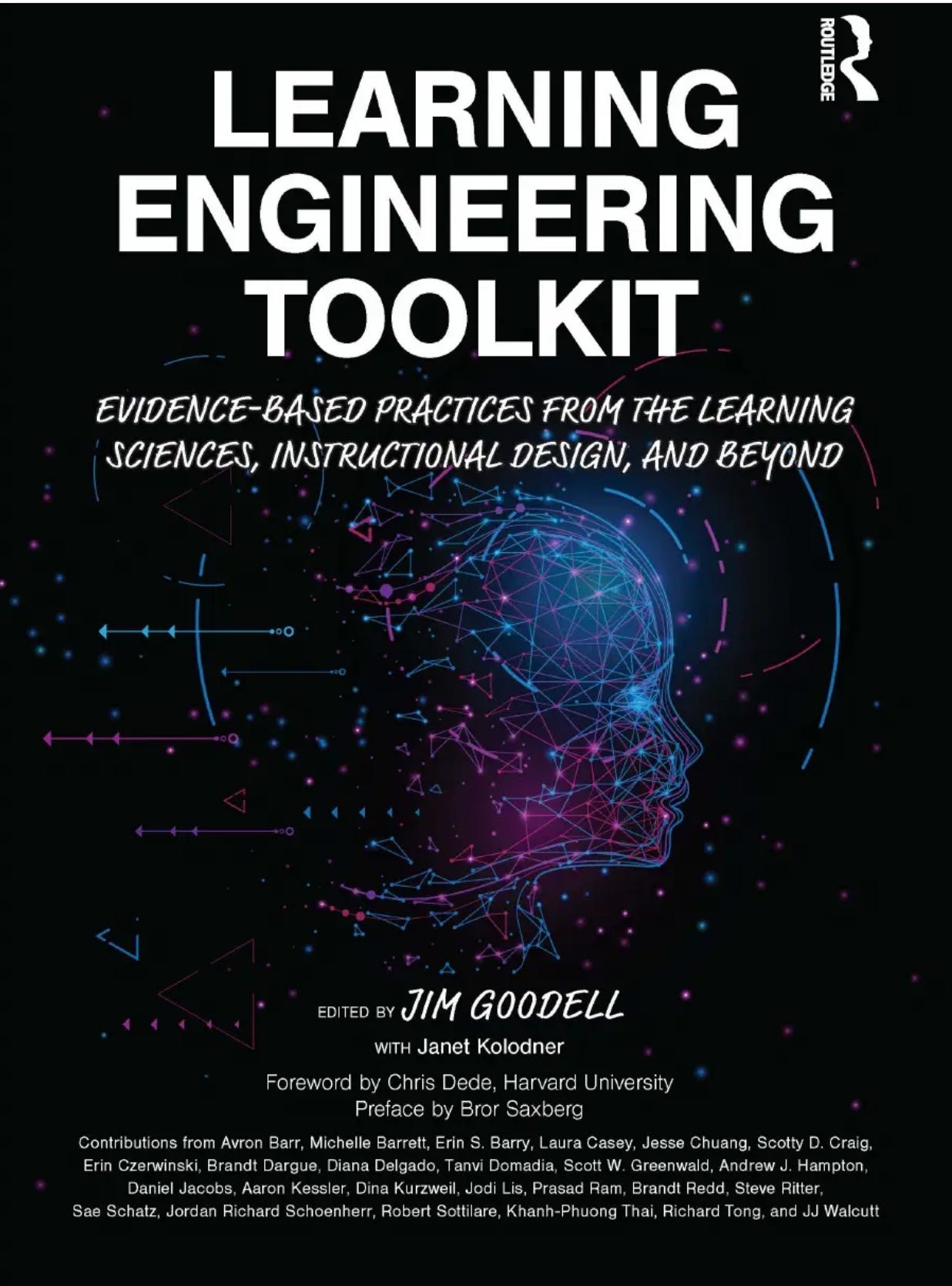
Learning Engineering Toolkit
Goodell, Kolodner, et al. (2023) | Routledge
PART 1: SECTION-BY-SECTION LOGICAL MAPPING
INTRODUCTION: What Is Learning Engineering?
Core Claim: Learning engineering is a distinct professional practice—not merely instructional design under a new name—defined as applying learning sciences through human-centered engineering design methodologies and data-informed decision-making to support learners.
Supporting Evidence:
The IEEE ICICLE consortium definition (2018–2019), developed through multi-disciplinary consensus
Historical grounding: Herb Simon coined “learning engineering” in 1967; Duolingo and Carnegie Learning cited as contemporary exemplars
The penicillin analogy: Fleming’s discovery was scientifically real but practically useless until Rousseau’s engineering team scaled production—learning science without engineering remains similarly stranded
Logical Method: Definitional argument via differentiation. The authors establish what learning engineering is by distinguishing it from what it is not (pure science, instructional design, ed-tech product development).
Logical Gaps:
The claim that learning engineering is “distinct” from instructional design is asserted more than demonstrated. The functional overlap between experienced instructional designers and the described learning engineer is substantial. The authors acknowledge this tension but do not resolve it: “what most education, training, and learning analytics professionals do daily only partially overlaps with the practice of learning engineering.” The qualifying word “partially” does significant lifting that is never quantified.
The penicillin analogy is rhetorically powerful but logically imprecise. Penicillin is a substance with measurable efficacy; “learning” is a heterogeneous construct measured inconsistently across studies. The analogy assumes that learning engineering can achieve the same kind of scaled, replicable delivery that chemical engineering achieved with penicillin—an assumption that the rest of the book only partially validates.
Methodological Soundness: The introductory framing is advocacy. Claims about the field’s distinctiveness should be treated as hypotheses, not established facts.
CHAPTER 1: Learning Engineering Is a Process
Core Claim: Learning engineering follows a repeatable cycle—Challenge → Creation → Implementation → Investigation—that is iterative, team-based, and always data-informed. The process is universal across scale, domain, and context.
Supporting Evidence:
MIT Electrostatic Playground case study: A VR physics learning experience developed iteratively through the full cycle, including novel instrumentation challenges and multiple implementation loops
The process model diagram (Figure 1.1) produced by Aaron Kessler for IEEE ICICLE’s Design for Learning SIG
Logical Method: Process description via worked example. The Electrostatic Playground case demonstrates each stage concretely, showing what “challenge,” “creation,” “implementation,” and “investigation” mean in practice.
Logical Gaps:
The claim that the process is “universal” is supported by one case study (MIT, privileged institutional context, advanced VR hardware, team with graduate research experience). The authors list other application domains but do not provide equivalent process-level detail for them. A donkey cart in Gambia and a VR electrostatics lab are claimed to follow the same framework—which may be true at a high level of abstraction, but the abstraction level is high enough to contain almost any design process.
The process model positions “team” as a contextual wrapper rather than a stage—this is appropriate for flexibility but creates ambiguity about when team composition decisions occur and who is responsible for making them.
Methodological Soundness: The case study is genuinely illuminating. The process model itself is sound as a heuristic framework, though its universality claim exceeds what one detailed case study can establish.
CHAPTER 2: Learning Engineering Applies the Learning Sciences
Core Claim: Learning engineering must be grounded in the learning sciences—cognitive psychology, neuroscience, education research—and practitioners require functional literacy in these sciences to design effective learning experiences. Expertise is built through progressive mental model refinement, not fact accumulation.
Supporting Evidence:
Hermann Ebbinghaus’s forgetting curve and spacing effect (1885), replicated extensively
Vygotsky’s Zone of Proximal Development
Kahneman’s System 1 / System 2 framework applied to expert vs. novice processing
De Groot’s chess master studies on pattern recognition and expertise
KLI Framework (Koedinger, Corbett, Perfetti 2012): three categories of learning events—memory/fluency, induction/refinement, understanding/sense-making
Logical Method: Conceptual scaffolding via narrative (fictional siblings Mia and Kai) plus theoretical synthesis. The narrative makes abstract cognitive science concepts accessible; the theoretical frameworks provide analytical precision.
Logical Gaps:
The chapter presents the learning sciences as a relatively settled body of knowledge from which clear design principles can be derived. The actual state of the field is considerably more contested. Effect sizes for many “established” interventions (growth mindset interventions, learning styles—which the chapter correctly dismisses—but also desirable difficulty and spacing effects in applied classroom settings) are substantially smaller and more context-dependent than the chapter implies.
The Gladwell “10,000 hours” claim is cited and then appropriately qualified, but the qualification is brief. The evidence for deliberate practice as the mechanism of expertise is strong; the evidence that any particular quantity of practice produces expertise in classroom or training contexts is much weaker.
The chapter’s fictional narrative (Mia and Kai) is pedagogically effective but creates a logical risk: the narrative implies causality (Mia’s block-playing caused her math proficiency) where the evidence supports only association.
Methodological Soundness: Strong as a conceptual introduction. Weaker as a guide to implementation, where the gap between lab findings and classroom application is consistently understated.
CHAPTER 3: Learning Engineering Is Human-Centered
Core Claim: Effective learning engineering requires deep, empathetic understanding of learner variability—demographics, culture, prior knowledge, developmental stage, motivation—and must actively involve diverse stakeholders in the design process. Generic solutions designed for an “average” learner systematically fail non-average learners.
Supporting Evidence:
Age of Learning Math Readiness case study: Extensive iterative persona development for two- and three-year-olds, with documented design changes driven by play-test data (motor skill findings, attention span, interface complexity thresholds)
Leti Arts KNO case study (Ghana): Participatory design with MSM population for HIV education game; design changes driven by community feedback including character physique, color palette, and narrative authenticity
Medic Mobile design cards: Enabling cross-language, cross-culture participation in health workflow design
Logical Method: Multiple case studies demonstrating the same principle (human-centeredness matters) across radically different contexts—toddler math games and HIV education for stigmatized populations. The range of cases strengthens the claim’s generalizability.
Logical Gaps:
The Math Readiness case study is the book’s most methodologically detailed, documenting specific design iterations with sample sizes. However, it does not report learning outcome data—only usability and engagement indicators. “Children all exhibited joy and excitement” is not equivalent to “children learned mathematics.” The chapter presents human-centered design as a prerequisite for effective learning, which may be true, but does not demonstrate that following these principles actually improved learning outcomes versus alternative designs.
The KNO case study is descriptive, not evaluative. Whether the game improved HIV risk behavior in the target population is not reported. The game’s distribution methodology (access codes, whitelist) may have systematically excluded the highest-risk individuals.
Design justice and participatory design principles are presented as unambiguously positive. The authors do not address the documented tension between inclusive co-design processes (which are slow, resource-intensive, and may not generalize beyond the specific community consulted) and the learning engineering goal of scalable solutions.
Methodological Soundness: Strong on process documentation, weak on outcome measurement. The chapter demonstrates human-centered design was done, not that it worked.
CHAPTER 4: Learning Engineering Is Engineering
Core Claim: Engineering principles—systems thinking, modular design, feedback control theory, cost scaling, constraints and tolerances, design patterns—apply directly to learning system design and provide a rigorous analytical framework that transcends instructional design.
Supporting Evidence:
Open edX development by Piotr Mitros: Explicit cost-benefit analysis of per-student vs. per-course vs. per-platform decisions; selection of pedagogical techniques based on return-on-investment; rapid MVP development (three months from concept to public launch)
Bror Saxberg at Kaplan: Engineering discipline applied to learning science adoption at scale
Control theory applied to feedback loops in learning: transfer functions, propagation delay, frequency and richness of feedback, the distinction between open-loop and closed-loop learning systems
Logical Method: Analogical reasoning from established engineering domains to learning engineering. The control theory section is the most technically rigorous in the book.
Logical Gaps:
The control theory application is illuminating but incomplete. A genuine closed-loop control system requires a reliable sensor (assessment), a known transfer function (relationship between instruction and learning), and a controllable actuator (instructional adjustment). The chapter correctly identifies all three as necessary; it does not address the fact that all three are substantially less reliable in learning systems than in physical engineering systems. Assessment reliability is typically 0.7–0.8 for well-designed instruments; transfer functions in learning are highly context-dependent and often unknown; the “actuator” (the instructional system) has much higher variance than a throttle position.
The Open edX case is presented as an engineering success, and by deployment metrics it was. But the chapter does not examine whether the specific pedagogical techniques chosen (active learning, mastery learning, etc.) actually produced the learning gains they were theorized to produce at scale. The MIT first-course 98.6% satisfaction rate is a lagging indicator of user satisfaction, not a leading indicator of learning.
The design pattern for deliberate practice (Section 6) is well-structured but presents a 10-step process that presupposes capabilities (baseline competency prediction, pedagogical models, real-time affective monitoring) that most learning engineering teams do not have.
Methodological Soundness: The engineering framework is genuinely valuable and underutilized in educational technology. The analogies are sound at a structural level. The chapter would be strengthened by explicitly quantifying where the analogy breaks down.
CHAPTERS 5 & 6: Learning Engineering Uses Data
Core Claim: Data instrumentation and analytics are not optional components of learning engineering—they are definitionally constitutive of it. Without data collection designed to answer specific questions and analytics applied to inform iterative improvement, the process is not learning engineering. Instrumentation must be designed alongside the learning solution, not appended after it.
Supporting Evidence:
US Army sensor research (Sottilare): Documented failure modes of sensors (webcam heart-rate monitoring degraded by distance and ambient light; Bluetooth galvanic skin response yielded intermittent data)—sensor limitations treated as design problems, not obstacles
Age of Learning My Math Academy: Multi-year process of building comprehensive instrumentation, documented lessons about data labeling, dictionary maintenance, and the cost of underspecified logging
Kaplan worked examples study: Controlled comparison (n per condition not specified) showing 8 worked examples outperformed 15 worked examples and 90-minute video instruction on LSAT logical reasoning post-test
Carnegie Mellon Discrete Math Primer: Three-year iterative improvement documented through learning curve analysis, showing measurable skill-specific improvement in functions (2016→2018) driven by targeted instrumentation changes
Ryan Baker’s research: “Gaming the system” detection via transaction logs; Scooter the Tutor intervention—effective in controlled experiment, failed to scale due to student and teacher rejection
Logical Method: Convergent evidence from multiple domains, with explicit attention to failure cases. The Baker/Scooter section is the book’s most important methodological lesson: quantitative evidence of effectiveness in controlled conditions does not guarantee scalability or adoption.
Logical Gaps:
The Kaplan worked examples study is presented as a model of data-driven decision-making, but sample sizes are not reported. The finding (8 examples > 15 examples > video + workbook) is counterintuitive enough to require replication; the chapter presents it as established.
The learning analytics process model (Figure 18.1, appearing in Chapter 18 but referenced here conceptually) conflates multiple distinct analytical traditions (psychometrics, machine learning, data mining) without clearly specifying which tools require which expertise levels or produce which types of evidence.
The chapter accurately states that “human intuition is often wrong” and that data-informed decisions outperform intuition. This claim is well-supported in the literature. But the chapter does not address the substantial evidence that data-informed decisions are also systematically wrong in specific ways—particularly when instrumentation is designed by the same team that designed the intervention, creating confirmation bias in measurement.
Methodological Soundness: The instrumentation chapter is the book’s most practically useful. The analytics chapter provides appropriate framework but would benefit from explicit calibration of when different analytical methods are and are not warranted by data quality and sample size.
CHAPTER 7: Learning Engineering Is Ethical
Core Claim: Ethical considerations are not post-hoc compliance requirements but are embedded in every design decision at every stage of the learning engineering process. Learning engineers must develop ethical sense-making capacity—the ability to identify ethically relevant features of situations that are often ambiguous.
Supporting Evidence:
APA’s five ethical principles applied to learning engineering contexts (beneficence/nonmaleficence, fidelity/responsibility, integrity, justice, respect for dignity)
Messick’s construct validity framework: Assessment has value implications beyond technical reliability
Design justice, reflective design, anti-discrimination design frameworks
Health care education examples: Anatomical donor programs, learner consent for research, attribution of technician contributions to publications
Logical Method: Framework application—established ethics frameworks from psychology, engineering, and design are mapped onto the learning engineering context with specific examples.
Logical Gaps:
The chapter presents multiple ethical frameworks (value sensitive design, reflective design, design justice, anti-discrimination design) without explicit guidance on how to resolve conflicts between them. Design justice’s emphasis on community leadership can conflict with learning engineering’s emphasis on data-driven validation. Reflective design’s focus on individual user sense-making can conflict with scalability requirements. These tensions are real and recurring; the chapter acknowledges them but provides limited guidance on navigation.
The SEEM-ED matrix (Sense-Making Ethical Evaluation Matrix for Ethical Design, Chapter 17) uses a three- or five-point Likert scale for ethical assessment. This quantification of ethical evaluation is methodologically problematic: averaging across raters on ethically charged questions obscures minority concerns that may be more ethically significant than majority views.
The chapter does not address the structural conflict of interest inherent in learning engineering: teams are typically funded by organizations whose interests may not align with learner interests. The ethical frameworks presented assume good-faith designers; the chapter does not provide tools for recognizing or managing institutional pressure toward ethically compromised design choices.
Methodological Soundness: Provides a genuinely useful framework for ethical awareness. Falls short of providing decision procedures for hard cases where ethical principles conflict with organizational, financial, or time constraints.
TOOLS SECTION (Chapters 8–18): Overview
Core Claim: The tools section operationalizes the foundation chapters. Each tool chapter provides practical instruments—templates, frameworks, checklists, process models—that learning engineering teams can apply directly.
Notable Chapters:
Chapter 8 (Understanding the Challenge): Task analysis, Five Whys, fishbone analysis, FMEA. These are established industrial quality-control tools applied to educational problem-finding. The tools are sound; the application to learning contexts is appropriate and the examples are concrete.
Chapter 9 (Learning Sciences Tools): Checklist-based distillation of Chapter 2’s concepts into design prompts. The metacognitive prompting design pattern is the section’s strongest contribution—a 5-step implementation procedure grounded in specific research constructs.
Chapter 10 (Teaming): Tuckman’s forming-storming-norming-performing model, DISC communication styles, dysfunction-to-remedy table. Standard organizational behavior content applied to learning engineering teams. Appropriate but not distinctive.
Chapter 15 (Learner Motivation): The motivating operations framework (autonomy, competence, value, meaning/purpose, avoidance, unpredictability, scarcity) synthesizes Pink, Chou, Friman, and Yuhas into an actionable crosswalk. The gamification analysis (Morford et al.) is the most empirically grounded section.
Chapter 16 (Implementation): The eleven-domain implementation framework (policies, budget, resources, leadership, team, technology, operationalization, instrumentation, investigation, ethics, scale-up) is the section’s strongest systemic tool. The Zambia e-learning case study demonstrates all eleven domains in practice, making the framework testable against a real deployment.
Chapter 18 (Data Analysis): The Learning Analytics Process Model (Figure 18.1) is the book’s most complex technical artifact. It correctly distinguishes Predict/Infer/Mine as fundamentally different analytical goals. The learning curve analysis tool (OLI/DataShop) is the section’s most practically demonstrated technique, with the graphical causal modeling course example showing a complete diagnostic-to-intervention cycle.
Logical Gaps Across Tools Section:
The tools are presented as largely additive: use task analysis AND five whys AND fishbone analysis AND FMEA. There is no guidance on when to use which tool, at what fidelity, or what sample sizes are needed before tools like learning curve analysis become statistically meaningful.
The SEEM-ED matrix (Chapter 17) and the data analysis tools (Chapter 18) assume teams with substantial expertise to operate. No guidance is provided on how to sequence tool acquisition or which tools provide the most value for teams with limited technical capacity.
CHAPTER 19: The Future World with Learning Engineering (Story)
Core Claim: [Narrative, not argumentative] Learning engineering practices, combined with AI, global data infrastructure, competency-based credentialing, and IoT sensor networks, will transform education from a time-bound, institution-bound activity into a continuous, personalized, life-long learning ecosystem.
Logical Gaps:
The story presents an optimistic extrapolation without examining the structural barriers to its realization: equity of access (who owns the AI-recommender infrastructure?), data sovereignty risks (the Autodex system requires trusting multiple private parties), and the political economy of credentialing (employer and credential authority resistance to disrupting existing certification systems).
The MYTCO trust score and distributed ledger system for data provenance are presented as solved technical problems. Both remain active research areas with unresolved challenges.
Methodological Soundness: Appropriate for a speculative closing narrative. Should not be read as evidence for the book’s central claims.
BRIDGE: The Book’s Logical Architecture
The book’s core argument is structurally layered:
Layer 1 (What it is): Learning engineering is defined by three constitutive elements—learning sciences, human-centered engineering design, and data-informed decision-making. Remove any one element and the practice collapses into something adjacent but distinct.
Layer 2 (Why it matters): The penicillin analogy frames the practical stakes. Learning science findings exist; the engineering infrastructure to deploy them at scale does not yet exist reliably. Learning engineering is that infrastructure.
Layer 3 (How to do it): The process model (Challenge → Creation → Implementation → Investigation) provides the operational skeleton. The tools section provides the instruments. The case studies demonstrate the skeleton in use.
Three tensions run through every chapter:
Tension 1: Rigor vs. Practicality. The book repeatedly advocates for controlled experimentation, learning curve analysis, and statistically valid outcome measurement. It simultaneously presents case studies where sample sizes are unstated, controls are absent, and the gap between “students expressed joy” and “students learned” is not acknowledged. The tools are more rigorous than the evidence cited to support them.
Tension 2: Universal Process vs. Context Specificity. The learning engineering process is claimed to be universal—applicable from toddler math games to military sniper training to HIV education in Ghana. The case studies consistently show that contextual specificity (of learner population, cultural norms, available infrastructure) dominates generic process. The framework is useful precisely because it structures attention to context, but the claim of universality is too strong.
Tension 3: Team Sport vs. Institutional Reality. The book envisions multidisciplinary learning engineering teams combining learning scientists, data engineers, UX researchers, subject matter experts, and assessment specialists. Most educational institutions and ed-tech companies cannot assemble or sustain such teams. The book does not address this structural gap except to note it briefly in the Educause quote about recruitment difficulty.
The book’s most proven claims:
Iterative, data-informed design produces better learning outcomes than one-shot design without measurement
Human-centered design—specifically involving members of the target population—catches design failures that expert-only design misses
Instrumentation must be designed concurrently with the learning solution, not added afterward
Sensor limitations and data quality issues are not edge cases—they are the norm, and must be anticipated
The book’s most significant unproven claims:
That learning engineering is sufficiently distinct from experienced instructional design to constitute a separate profession
That the process model generalizes across the full range of claimed contexts with equivalent fidelity
That the tools section, applied by practitioners without deep expertise, will produce measurably better learning outcomes
The book’s most significant acknowledged gap: The chapter summaries explicitly note that “learning sciences findings [are] not yet applied at scale”—the book’s own central problem statement. After 400 pages of framework and tools, the gap between demonstrated effectiveness in controlled contexts and reliable scaled impact remains open. The authors know this; they name it honestly. What the book provides is the best current professional framework for working toward that gap’s closure.
PART 2: LITERARY REVIEW ESSAY
The Engineering That Education Has Always Needed (And Still Mostly Lacks)
Consider the institutional paradox that structures this book from its first pages to its last: we have known for decades that one-on-one tutoring dramatically outperforms classroom instruction, that spaced practice dramatically outperforms cramming, that feedback must be timely and specific to produce learning, that learner variability is the rule rather than the exception. Hermann Ebbinghaus established the forgetting curve in 1885. Lev Vygotsky articulated the zone of proximal development in the 1930s. Benjamin Bloom documented the two-sigma tutoring advantage in 1984. The learning sciences are not a young discipline waiting for its first findings. They are a mature discipline whose findings have been systematically ignored by the institutions responsible for deploying them at scale.
The Learning Engineering Toolkit edited by Jim Goodell and Janet Kolodner begins from this observation and builds a professional framework designed to close the gap. The book’s central argument is clean: what transformed penicillin from a laboratory curiosity into a mass-produced life-saving drug was not better chemistry but better chemical engineering. Margaret Hutchinson Rousseau’s team at Pfizer did not discover anything Fleming and the Oxford team had not already found. They built the production system. Learning engineering, the authors argue, is the equivalent discipline for human learning—the infrastructure that converts scientific knowledge into reliable scaled impact.
This is a good argument. It is, in fact, the argument that the educational technology field has needed someone to make with sufficient rigor and institutional backing to matter. The book’s breadth of authorship—twenty-nine contributors from cognitive science, software engineering, data science, instructional design, human factors, ethics, and military training—represents a genuine attempt at the interdisciplinary synthesis the field requires. Where the book succeeds, it succeeds significantly. Where it falls short, the failures are instructive precisely because they reveal the hardness of the problem.
The book’s most important contribution is not any individual tool or framework but a single insistence: data instrumentation must be designed with the learning solution, not appended to it afterward. This sounds obvious once stated. In practice, it is violated constantly. Educational interventions are routinely deployed, deliver unreliable anecdotal feedback for years, and are then subjected to belated efficacy studies whose results cannot drive improvement because the intervention was never built to be iterable. The learning engineering process model—Challenge, Creation, Implementation, Investigation as a continuous cycle rather than a linear sequence—is designed to make this mistake structurally impossible.
The MIT Electrostatic Playground case study in Chapter 1 demonstrates why this matters. The VR physics learning experience was not simply designed and deployed; it was simultaneously designed and instrumented, with the data infrastructure built alongside the learning experience so that the resulting data could drive the next iteration. When the team discovered that their logging system could not easily capture joint student attention in 3D space—precisely the collaborative phenomenon they were studying—they rebuilt the logging system. That is engineering thinking applied to learning research: identifying the gap between what your sensor captures and what your question requires, and closing the gap before drawing conclusions.
This discipline is genuinely rare in educational practice. Most research on educational interventions uses outcome measures designed independently of the intervention, collected once at the end, and analyzed by researchers who were not involved in design. The learning engineering process inverts this: measurement is a design constraint from the beginning, not an evaluation appended at the end.
The book’s single most important case study appears quietly in Chapter 6, and it is Ryan Baker’s Scooter the Tutor.
Baker and his colleagues developed an animated puppy character that responded to student behavior in an intelligent tutoring system—appearing happy when students engaged productively, increasingly distressed when they gamed the system by harvesting hints rather than attempting problems. The intervention worked. In controlled experiments, students gamed the system about half as much when Scooter was present, and students who gamed less learned significantly more. Baker documented this in his doctoral dissertation. The evidence was solid.
Then it was deployed. Teachers didn’t like Scooter. Students who gamed the system—the exact students the intervention was designed to help—didn’t like Scooter and told their teachers it hurt their learning. Schools using the software stopped using the Scooter feature. The intervention that worked in controlled conditions failed to scale because it failed to account for the social and institutional context of actual school deployment.
There is a further footnote: in some other countries, Scooter worked. In some countries, students would share answers before entering them—rendering the individual-student-behavior model irrelevant. The same intervention, the same software, produced different results in different social contexts.
Baker’s honest accounting of this failure—unusual in an academic field that systematically underreports negative results—is the book’s most important methodological lesson. It states explicitly what the book’s framework implies but never quite says directly: controlled experimental evidence of effectiveness is a necessary but not sufficient condition for deployment confidence. The path from “works in a lab” to “works at scale in diverse contexts” is long, and the tools chapters are largely designed to shorten that path rather than to close it.
The book’s deepest unresolved tension is the gap between the interdisciplinary team it envisions and the institutional reality it does not sufficiently address.
The Educause Learning Initiative’s definition of a learning engineer—quoted on page 11—lists required expertise in instructional design, artificial intelligence and machine learning, pedagogy and andragogy, systems design, user experience design, product testing, and the development of policies, regulations, and standards. The authors immediately acknowledge: “It’s extremely rare for any one person to have expertise in all of these areas.” Their solution is the learning engineering team—a multidisciplinary ensemble whose collective expertise covers the full range.
This is correct as a prescription. It is largely aspirational as a description of actual practice. Most school districts, most universities, most ed-tech startups, and most corporate training departments cannot assemble or sustain such a team. The book presents Carnegie Learning, Duolingo, Age of Learning, and MIT as case study exemplars. These organizations have access to capital, research infrastructure, and talent pools that are structurally unavailable to the vast majority of learning engineers who might read this book.
The Zambia e-learning case in Chapter 16 is the book’s most honest confrontation with resource constraints. A CDC-funded international health organization implemented mobile e-learning for health workers in a country where most facilities lacked internet connectivity, where tablets had to be procured and distributed, where the Ministry of Health had no LMS, no e-learning office, and no institutional knowledge of digital learning at program launch. The case is documented with unusual completeness across all eleven implementation domains. It is also, quietly, a case study in what learning engineering looks like when most of the prescribed tools are unavailable: iterative, adaptive, human-centered, and substantially less technically sophisticated than the framework implies. That it succeeded—ten thousand health workers registered by 2021—suggests that the framework’s principles matter more than its tools.
The authors are honest about the book’s limitations in ways that are worth naming explicitly. Chapter 2 ends by quoting Sawyer’s Cambridge Handbook of the Learning Sciences directly: “efforts to design effective learning environments cannot be based solely on scientifically validated theories of learning: theoretical advances are often too slow in coming, too blunt, and too idealistic.” Chapter 4 acknowledges that Piotr Mitros’s pedagogical guesses for Open edX were right only about half the time. Chapter 6 presents the Kaplan worked examples finding—8 examples outperforming 15—without reporting sample sizes, an omission that a book this concerned with methodological rigor should not make.
These acknowledgments are not fatal to the book’s argument. They are, in fact, the argument’s most honest articulation. Learning engineering does not promise certainty. It promises a systematic process for getting less wrong over time. The field’s claim is not that following the framework will guarantee effective learning—it is that following the framework will surface failures faster, fix them more efficiently, and produce evidence that accumulates into something more reliable than the anecdote-driven practice that precedes it.
That is a modest but defensible claim. It is, in the history of applied fields, exactly how professions mature. Civil engineering did not begin with structural analysis; it began with bridges that sometimes fell and the systematic investigation of why. Learning engineering is at an earlier stage than that, but it is building the investigative infrastructure that eventually produces reliable bridges.
The book’s closing vision chapter—five narrative vignettes from a speculative future—is the section most likely to age poorly. The Autodex credentialing system, the MYTCO trust score, the IoT-enabled agricultural lessons for Rwandan secondary students with 6G connectivity—these are technological optimisms whose political economy is not examined. Who owns the AI recommender infrastructure? Who governs the distributed ledger? Who sets the competency definitions that become the currency of the credential economy? These are not technical questions. They are questions about power, and the book’s framework has limited tools for them.
What the book does well, it does better than any comparable text in the field. It synthesizes a genuinely interdisciplinary body of practice into a coherent professional framework. It documents failure cases with unusual honesty. It provides tools that are, in most cases, immediately applicable by practitioners without advanced technical training. It insists on measurement without pretending measurement is easy.
The field of learning engineering is at the stage where it knows the right questions. The Learning Engineering Toolkit does not answer those questions—it could not, because the answers require the kind of scaled, longitudinal, diverse implementation that no single text can provide. What it does instead is equip practitioners to pursue the answers systematically. For a field that has spent decades generating findings without building the systems to deploy them, systematic pursuit is itself a form of progress.
The real test of this framework will not be in the analysis of the book itself but in the next generation of practitioners who apply it, iterate it, and produce the evidence base that its own methodology demands.
Tags: learning engineering toolkit Goodell Kolodner, iterative instructional design framework, learning sciences applied practice, data-informed educational decision-making, human-centered design education