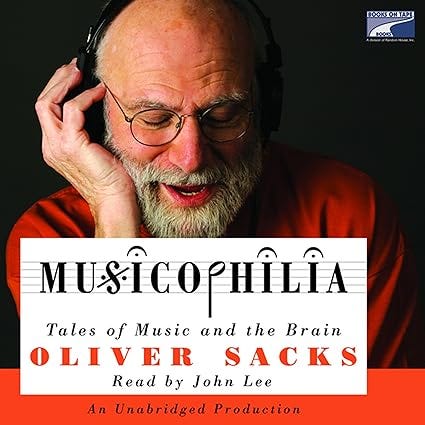
Musicophilia: Tales of Music and the Brain
The machinery works fine — until it doesn't, and then you can see exactly what it was doing all along.
CHAPTER SUMMARIES
Preface: The Musical Species
Sacks opens with Arthur C. Clarke’s alien overlords, puzzled by humanity’s devotion to “meaningless tonal patterns.” The preface establishes music as species-defining: present in every culture, observable in infancy, neurologically complex. Sacks surveys the debate over music’s evolutionary origins — Darwin’s proto-sexual song, Spencer’s emotional speech, Pinker’s dismissal of music as biological noise — without resolving it. What concerns him is the machinery: auditory systems tuned for music, motor systems that respond to rhythm involuntarily, memory systems that engrave melodies for decades. And what concerns him equally is when this machinery breaks down, or breaks loose.
Part 1: Haunted by Music
Chapter 1 — A Bolt from the Blue: Sudden Musicophilia
Tony Cicoria, 42, an orthopedic surgeon with no particular musical interest, is struck by lightning in 1994. He survives a near-death experience and an out-of-body experience, recovers neurologically, returns to work. Then, six weeks later, an insatiable craving for piano music arrives without warning. He buys recordings, orders sheet music, teaches himself Chopin. Music begins arriving in his dreams — not recalled music but original composition, what he calls “a frequency, a radio band.” He becomes possessed, practicing at 4 a.m., composing obsessively. Sacks cannot explain the mechanism fully. Temporal lobe sensitization? Subcortical reorganization during recovery? Cicoria himself prefers the spiritual account — saved for a reason, given a mission. Sacks does not dismiss this, only notes that even the most exalted transformations must have a neural correlate. A second case, Salima M., develops musicophilia following surgery for a temporal lobe tumor. A third patient in the literature develops it only after anticonvulsant medication controls her seizures. All three suggest a limbic-perceptual hyperconnection: the hearing of music suddenly wired directly to emotion.
Chapter 2 — A Strangely Familiar Feeling: Musical Seizures
John S. hears classical violin in a closet before losing consciousness. Eric Markowitz, a musician with an inoperable astrocytoma, hears music “explode” in his head during seizures — hauntingly familiar, unidentifiable, exerting a near-hypnotic pull. Both experience Hulings Jackson’s “doubling of consciousness”: seizure-self and observing-self coexisting. The hallucinatory music feels external, feels heard rather than imagined, yet cannot be identified even by trained musical ears. Eric, as a songwriter, distinguishes sharply between his intentional musical imagery and the epileptic music: one is invited, the other invades. He composes music inspired by the seizures, trying to capture their “mysterious and ineffable quality.”
Chapter 3 — Fear of Music: Musicogenic Epilepsy
Critchley’s 1937 taxonomy of seizures triggered by music. Sacks updates it with contemporary cases. GG, recovering from herpes encephalitis, develops seizures provoked by almost any music — a Verdi aria on a cell phone induces a complex partial seizure within thirty seconds. Sylvia N. is triggered exclusively by Neapolitan songs from her childhood, songs with “meaning,” songs that “put them on” at every family celebration. Her seizures involve temporal displacement — she relives scenes as a teenager, sometimes glimpses the future (”My grandmother opened the gates of heaven”). Surgery eliminates both the focus and the vulnerability. She can now play the trigger songs at full volume. She is cured, and occasionally nostalgic.
Chapter 4 — Music on the Brain: Imagery and Imagination
The range of internal musical life. Sacks’s father carries orchestral scores in his pockets and conducts private concerts in his mind. Sacks himself has a pianist’s imagery — starting a Chopin mazurka in memory, feeling his hands move. Brain imaging confirms that imagining music activates auditory cortex almost as strongly as hearing it, and that imagining playing activates motor cortex. The “White Christmas Effect”: subjects hear a familiar song when the volume drops to zero, filling in the silence with expectation. Brains supersaturated by repeated listening replay music involuntarily. Proust’s “little phrase.” A composer discovers, via a bathroom break, that his unconscious had been storing a forty-year-old pop song, and deploying it as a time signal. Musical memory reaches deeper than most other memory, appears spontaneously, carries meaning we have not consciously assigned.
Chapter 5 — Brainworms, Sticky Music, and Catchy Tunes
Earworms. Nick Eunice trapped for ten days inside “Love and Marriage.” Mark Twain’s 1876 story of a jingling rhyme that spreads like infection through an entire congregation. Sacks traces his own childhood brainworms — “Khad Gadya,” 46 iterations of six notes per Passover seder, hammered neurally by repetition and liturgical weight. Rose R., a postencephalitic patient, confined for years to “a musical paddock” of fourteen notes from Rigoletto’s Boléro. The epilepsy parallel: sudden onset, stereotyped content, self-perpetuating, resistant to will. Sacks proposes that the modern ubiquity of earworms is partly environmental — music now inescapable, the auditory system bombarded, the threshold for involuntary replay lowered. Before recording and broadcast, one had to seek music. Now it finds you.
Chapter 6 — Musical Hallucinations
Cheryl C., 70, profoundly deaf, wakes to the sound of trolley bells, then Rodgers and Hammerstein, then patriotic songs cycling uncontrollably at deafening volume. She knows no orchestra is playing. The experience is nothing like musical imagery — it has the full force of perception. Dwight Mamlock hallucinates Nazi marching songs from his Hamburg childhood, songs he hates, followed by Tchaikovsky, also unwanted. John C., an eminent composer, has an iPod in his head playing childhood pop songs he finds aesthetically contemptible, his pianist’s hands automatically transcribing them. Sacks catalogs the phenomenology: apparent exteriority, fragmentary repetition, involuntary content, high loudness, partial controllability. The mechanism is Konorski’s deafferentation theory: without normal auditory input, the auditory brain generates its own. PET imaging confirms that hallucinated music activates the same neural networks as real music — temporal lobes, frontal lobes, basal ganglia, cerebellum. Gordon B., a professional violinist, hallucinates non-stop while practicing; his wife cannot tell. Leo Rangel, a psychoanalyst who developed hallucinations at 82 after bypass surgery, spends a decade in self-analysis, finding the songs “structured like a dream” — emotionally meaningful, associatively linked, shaped by grief for his wife.
Part 2: A Range of Musicality
Chapter 7 — Sense and Sensibility: A Range of Musicality
Rebecca West’s Cordelia: perfect ear, absolute pitch, no musical sensibility. Somerset Maugham’s George: passionate feeling, inadequate ear. Sacks uses them to introduce the thesis that musicality comprises dissociable components — perceptual accuracy, emotional depth, taste, motor skill — and that individuals may excel in some while failing in others. Brain imaging confirms that professional musicians have enlarged corpora callosa, asymmetric planum temporale, increased gray matter in motor, auditory, and visuospatial cortex. These differences correlate strongly with the age at which training began. Jerry Marx, born into a musicless household, discovers music at 14 through physics, teaches himself guitar, becomes passionate. Biological potential requires environmental activation. But activation cannot manufacture what is absent.
Chapter 8 — Things Fall Apart: Amusia and Disharmonia
Mrs. L., 76, has never heard music as music. What others call melody she hears as pots and pans thrown across a kitchen. She has congenital amusia — profound impairment of pitch discrimination combined with distamber, so that even the tonal quality of individual notes is shattered. She functions normally in all other respects, enjoys poetry read dramatically, loves tap dancing when no music accompanies it. Sacks has his own experience of acquired amusia during a migraine: Chopin’s ballad reduced to toneless banging on sheet metal, rhythm intact, all melody gone. Rachel Y., a composer and performer, suffers a car accident at 43 that leaves her with disharmonia — she hears musical voices as four laser beams pointing in four directions, unable to integrate. She can no longer hear harmony. She can read a score and infer what she has lost but cannot perceive it. She responds by teaching herself to paint, composing music with a collaborator and computer, eventually assembling a new piece from a pre-accident string quartet — deliberately disassembled, the fragments caught and reconstituted.
Chapter 9 — Papa Blows His Nose in G: Absolute Pitch
The seven-year-old Frederick Ouseley identifies his father’s sneeze as G. The entomologist Sotavalta measures moth wingbeats by their pitch (46 Hz, a low F-sharp). Absolute pitch as a qualitative parallel to color vision: each tone has its own chroma, its own flavor. It is estimated at less than one in ten thousand in general populations — yet Diana Deutsch’s work shows that 60% of Chinese music students who began training before age five have it, versus 14% of American non-tonal-language speakers. The critical period aligns with early language acquisition. Native speakers of tonal languages may retain in music what the rest of us inhibit. Frank V., a composer who loses absolute pitch to aneurysm rupture, describes the loss as becoming color-blind. The cortical correlates of absolute pitch include asymmetric planum temporale and frontal lobe activation during pitch labeling — the first purely perceptual, the second learned.
Chapter 10 — Pitch Imperfect: Cochlear Amusia
Jacob L., a distinguished composer in his 60s, finds the upper register of every piano grotesquely sharp — not equally sharp, but erratically so, one note a quarter-tone off, its neighbors a semitone, one anomalous E-flat slightly flat in an otherwise normal register. His audiologist confirms correspondence between hearing loss and pitch distortion. Jacob discovers that orchestral richness normalizes the distortions — context repairs what isolation deforms. He can sometimes pull a note to correct pitch by concentration, an act he compares to the face-vase illusion — willing one’s perception to adopt a different interpretation. The mechanism: efferent olivocochlear fibers run from brain to cochlea, providing top-down modulation. The brain does not merely receive; it tunes. After three years of compositional immersion — working through a full-range twelve-tone orchestral score — Jacob’s distortions substantially resolve. Intensive musical activity has literally reshaped his auditory cortex.
Chapter 11 — In Living Stereo: Why We Have Two Ears
Dr. Jørgensen loses all hearing in one ear following acoustic neuroma surgery. Mahler’s Seventh, which once shattered him, sounds “hopelessly flat and lifeless.” Six months later, a pseudo-stereo effect develops: the right hemisphere recruiting remaining auditory input, supplemented by visual scanning of the orchestra, head movements amplifying monaural cues, tactile subwoofer resonance. Howard Bransen, a hunter, discovers after one-sided deafness that he can no longer locate sounds in the forest; he relearns via deliberate head scanning combined with visual-auditory synthesis. The chapter is a study in neural compensation: the brain never simply accepts a deficit but immediately begins to construct workarounds.
Chapter 12 — Two Thousand Operas: Musical Savants
Martin, a retarded postencephalitic patient at Beth Abraham, knows more than 2,000 operas, all of Bach’s cantatas, the Messiah, the Christmas Oratorio. He can reproduce unfamiliar Debussy after a single hearing and transpose it. Stephen Wiltshire, the autistic visual savant, erupts with “huge musical powers” at 16: absolute pitch, instant melodic recall, improvisation, transposition. Sacks reviews the savant literature: isolated perceptual and mnemonic skills, often accompanied by underdevelopment of abstract verbal thought, possibly related to right hemisphere compensation for left hemisphere damage. Geschwind and Galaburda’s hypothesis: left hemisphere damage in utero or early infancy prompts compensatory right hemisphere overdevelopment. Snyder’s TMS experiments: brief inhibition of the left temporal lobe produces transient savant-like improvements in drawing and calculation in normal subjects. The implication: savant mechanisms may be latent in many, ordinarily suppressed by the dominant hemisphere’s abstract overlay.
Chapter 13 — An Auditory World: Music and Blindness
The blind piano tuner as cultural archetype. Jerome Bruner’s congenital cataracts unrepaired until age two: a lifetime of heightened auditory sensitivity follows. Martin’s severe early farsightedness: functionally blind until nearly three, profoundly musical thereafter. Ockleford’s systematic studies at a school for the blind: 40-60% of blind children have absolute pitch, versus perhaps 10% of sighted musicians. Early blindness not only fails to inhibit absolute pitch development — it actively promotes it. The massive visual cortex, reallocated to hearing and touch in the congenitally blind, enhances auditory processing by a full order of magnitude in some pitch-discrimination tasks. Jacques Lusseyran, blinded at seven, describes his first concert at eight: “A world of sounds for a blind man, what sudden grace.”
Chapter 14 — The Key of Clear Green: Synesthesia and Music
Michael Torke hears D major as blue, specifically the blue of a clear sky. He has had key-color synesthesia as long as he has had absolute pitch; without the latter, he thinks, the former would be impossible — each key must be absolutely distinguishable before each can acquire its own hue. David Coldwell has music-color synesthesia without absolute pitch, using relative pitch to infer key, the color following the inference. Patrick Ellen perceives virtually every musical parameter — rhythm, tempo, melody, instrument timbre, harmonic richness — as a continuous flow of visual sensation, central to his composing. Christine Leihy’s chromesthesia derives from colored refrigerator-magnet letters learned in childhood: sharps and flats, absent from that alphabet, appear as blanks in her musical palette. Ramachandran and Hubbard’s fMRI confirmation: visual color areas activate in synesthetes when they hear music. The developmental hypothesis: synesthetic cross-activation may be universal in infancy, pruned by cortical maturation, preserved in those with a genetic abnormality preventing full pruning.
Part 3: Memory, Movement, and Music
Chapter 15 — In the Moment: Music and Amnesia
Clive Wearing, formerly an eminent musicologist and conductor, contracts herpes encephalitis in 1985. His memory span collapses to seconds. He lives in a perpetual present, each moment experienced as the first moment of consciousness. His journal fills with contradicting entries: “I am awake. I was never awake before.” His entire autobiographical past is deleted. Yet two things survive intact: his love for his wife Deborah — he greets her with desperate passionate relief every time she appears, even minutes after her last departure — and his musicianship. He can sight-read, play piano and organ with full fluency, conduct a choir with sensitivity and professional grace, improvise, transpose. Once music begins, the momentum of its structure carries him: each bar contains the next, each phrase implies the phrase following. “Remembering music is not, in the usual sense, remembering at all,” Sacks writes. Musical time is entirely present-tense. Victor Zuckerkandl: “Hearing a melody is hearing, having heard, and being about to hear, all at once.”
Chapter 16 — Speech and Song: Aphasia and Music Therapy
Samuel S., rendered totally speechless by stroke, is discovered singing “Ol’ Man River” outside the music therapy clinic — getting two or three words, but the melody intact. Two months of music therapy with Connie Tomaino later, he can produce short appropriate responses to questions. Melodic intonation therapy (Albert et al., 1973): patients sing simple phrases, then the melodic element is gradually removed. One man, aphasic for 18 months, had an effective vocabulary of a hundred words within two weeks and short meaningful conversations within six. The mechanism, revised from Albert’s original hypothesis: not activation of right hemisphere language potential, but suppression of hyperactive right Broca’s area — which, in Broca’s aphasia, exerts a pathological inhibitory effect on the damaged left Broca’s area. Singing engages the right hemisphere in normal activity, releasing it from this pathological inhibition. The left Broca’s area, released, begins to function. Schlaug’s current work confirms significant changes in right hemisphere frontal-temporal networks with 75 sessions of intensive melodic intonation therapy, effects that persist months after treatment ends.
Chapter 17 — Accidental Davening: Dyskinesia and Cantillation
Solomon R.’s rhythmic dyskinesia — forcible expirations, abdominal contractions, bowing movements — gradually acquires a melody, a prosody, and then fragments of Hebrew. He appears to be davening, though he is not particularly religious and the Hebrew words are semantically random. He finds in this accidental ritual a deep satisfaction: not a victim of automatism, but a participant in something ancient. On the day Sacks arrives with a tape recorder, he enters the ward to find a Sabbath service in progress. The rabbi is also bowing rhythmically, cantillating. The direction of cause has simply reversed.
Chapter 18 — Come Together: Music and Tourette’s Syndrome
John S.’s Tourette’s is modulated by music — some triggering surges, some producing states where Tourette’s disappears entirely. Sydney A., with a rare phantasmagoric form, responds to Western music with wild mimetic cascades — a “Tourette’s representation” of the music’s emotional and imagistic landscape. Ray G., a jazz drummer, finds that a convulsive tic can initiate a cascade of percussive invention. David Aldridge, a professional drummer, describes learning to harness Tourette’s energy “like a high-pressure fire hose.” Nick Van Bloss, who tics forty thousand times a day, touches the piano keys and his tics nearly vanish — “touch heaven” for his compulsive fingers. Tobias Picker, composer: “I live my life controlled by Tourette’s, but I use music to control it.” Matt Jordano’s drum circle at which thirty Tourette’s patients, all ticking in their own time, synchronize within seconds of music beginning.
Chapter 19 — Keeping Time: Rhythm and Movement
Sacks rows himself down a Norwegian mountain to the Volga Boatmen, then walks again in hospital to an imagined Mendelssohn violin concerto. A nursing home patient with a “paralyzed” leg moves it spontaneously to an Irish jig at Christmas, then recovers full use through music therapy. The neural basis: Chen, Zatorre and Penhune demonstrate that imagining music activates motor cortex as powerfully as listening to it, and that keeping time depends on an auditory-dorsal premotor connection present only in the human brain. Patel’s 2006 thesis: musical rhythm — a regular, anticipatable pulse — is unique to music and cannot be explained as a byproduct of linguistic rhythm. No animal has been reliably trained to synchronize with an external auditory beat. This capacity, Patel argues, evolved independently. Donald’s mimetic culture thesis: rhythm as the quintessential mimetic skill, binding individuals into communities, coordinating labor, enabling the collective body to act as one.
Chapter 20 — Kinetic Melody: Parkinson’s Disease and Music Therapy
Beth Abraham Hospital, 1966. Forty postencephalitic survivors, frozen or driven, many untreated for decades. Kitty Stiles, the music therapist, the most important person on the ward. Music as pharmacology: it does everything L-dopa would later do — unlocking frozen patients, normalizing accelerated ones, restoring kinetic melody — but only for the duration of the music, and a few minutes beyond. Francis D. is “compressed, clenched and blocked” before music begins; afterward she rises to conduct it. Edith T., “un-musicked” by Parkinsonism, finds that imagining music can restore her gait: “It was like suddenly remembering myself, my own living tune.” Ed N., with opposite-sided speed asymmetry that no medication can correct, can synchronize his two hands only at the piano. Rosalie B.’s EEG normalizes when she imagines Chopin’s Opus 49. The problem in Parkinsonism is not the absence of motor programs but the inability to initiate them without external cueing. Music provides what the damaged basal ganglia cannot: temporal organization, drive, a scaffold for voluntary movement.
Part 4: Emotion, Identity, and Music
Chapter 21 — Phantom Fingers: The One-Armed Pianist
Paul Wittgenstein loses his right arm in World War I, commissions concertos from Ravel, Prokofiev, Britten, Korngold, and others, performs them. His student Erna Otten observes his stump moving in agitated patterns when he works out fingering for a new piece — moving for fingers he no longer has. Weir Mitchell’s Civil War amputees, the first systematic account of phantom limbs. Contemporary neuroscience confirms: the missing limb remains represented in the cortex, its territory concentrated and hyperexcitable in the stump area. Bionic prosthetics now under development require precisely this phantom motor signal — the ghost must move before the machine can.
Chapter 22 — Athletes of the Small Muscles: Musicians’ Dystonia
Leon Fleischer at 36 finds his fourth and fifth fingers curling under when he plays. He fights it, works harder, worsens. A year later he cannot perform. Gary Graffman’s public acknowledgment in 1981, then Fleischer’s, breaks the professional silence that had surrounded focal dystonia for decades. Marsden’s 1982 identification of the basal ganglia connection. Hallett’s discovery that the sensory cortex in dystonic hands is disorganized — finger representations enlarged, overlapping, de-differentiated. The mechanism: rapid repetitive movement at or near system capacity → sensory overload → cortical remapping → motor misfiring → more practice to compensate → worsening. Kandia’s sensory retraining: deliberate perceptual rehabilitation to re-differentiate the fused representations. Botox as temporary intervention. Fleischer’s recovery through Rolfing plus Botox, his return to two-handed performance after 40 years. “You work with the ears you have. Not the ears you want.” His prescription: “Treat yourself as an athlete of the small muscles.”
Chapter 23 — Awake and Asleep: Musical Dreams
Sacks hears, in a hypnopompic state after weeks of Mendelssohn saturation, the concerto continuing as he wakes — reaches for the tape recorder, finds it off, the hallucination vanishing with full consciousness. A friend wakes into post-siesta hypnopompia to find “an orchestra in the room.” Wagner’s account of the orchestral introduction to Das Rheingold arriving in a somnolent state on a hard couch — the chord of E-flat major flowing out of the sound of rushing water. Berlioz dreams an entire symphony allegro in A minor, twice, then suppresses it for fear of the financial consequences of composition. The symphony is lost forever. Sacks dreams Mahler’s Kindertotenlieder the night after abandoning a ward of children and burning a book of essays. His friend Alan Fox, interpreting the dream, names the piece. The music vanishes the moment interpretation arrives.
Chapter 24 — Seduction and Indifference
Music requires both structural perception and emotional response, and these are dissociable. Florence Freedman, a physician, loses emotional response to music following concussion — he hears it, recognizes it as music, knows he used to love it, feels nothing. The specific loss passes in days. One patient described in the literature is rendered amnesic to familiar melodies by stroke yet still cries at music she cannot recognize. Peretz’s patient I.R., with bilateral temporal lobe infarctions, scores near zero on melody recognition but reports that she can still enjoy music — testing confirms this. Temple Grandin, whose amygdalae are poorly developed, finds Bach “ingenious” and wonders about four-part inventions but is not moved. Freud, living in musical Vienna, avoids music actively and explains why in a single passage: “some rationalistic, or perhaps analytic, turn of mind in me rebels against being moved by a thing without knowing why.” The resistance, perhaps, is the point.
Chapter 25 — Lamentations: Music and Depression
John Stuart Mill, stripped of emotional development by his father’s relentless intellectual regime, finds music alone can pierce his anhedonia. William Styron, near suicide, hears a contralto passage from the Brahms Alto Rhapsody and is pierced: in a flood of recollection, the joy the house had known comes back. Sacks, frozen in grief after his beloved aunt’s death, passes an open basement window from which Schubert pours — he laughs aloud for the first time in weeks, then loses the thread as he walks away. At a Fischer-Dieskau recital, weeks later, Winterreise sounds completely flat: the performance, later confirmed as brilliant, is inaccessible because the listener has sealed himself against feeling. Music’s cathartic power “must steal on one unawares, come spontaneously as a blessing or a grace.” It cannot be demanded. Forster: “The arts are not drugs. They are not guaranteed to act when taken.”
Chapter 26 — The Case of Harry S.: Music and Emotion
Harry S., a brilliant mechanical engineer, suffers bilateral frontal lobe hemorrhage at 37. He loses his wife, his career, his emotional life. He reads Scientific American from cover to cover and retains nothing that interests him. He sits among the distressed and joyful patients of Beth Abraham entirely unmoved. But when he sings Irish songs, his face fills with every appropriate emotion — jovial, wistful, tragic, sublime. Music appears to substitute for his damaged frontal lobes, providing emotional organization and coherence that otherwise does not exist. When the song ends, within seconds he is vacant and inert again. His colleague Goldberg’s question: is this genuine emotion or elaborate mimicry? Sacks, watching Harry sing “Good Night Irene” with full tenderness and delicacy at 96, a week before his death, chooses not to answer definitively. The question, perhaps, is unanswerable — and perhaps not the right question.
Chapter 27 — Irrepressible Music and the Temporal Lobes
Vera B., admitted to a nursing home at 72, sings non-stop in Yiddish, Spanish, Italian, English, and invented polyglot combinations. Connie Tomaino: “She’s musical now.” Lewis F., with frontotemporal dementia in his 60s, sings upbeat songs with gusto while unable to define what an ocean is. Sacks watches him sing a nonsensical version of “My Body Lies Over the Ocean” with identical conviction and emotion as the original — the emotion detached from the meaning it once served. Miller’s findings: emergence of unprecedented musical or artistic talent occurs specifically with left anterior temporal lobe degeneration, releasing right hemisphere perceptual and musical capacities from normal inhibitory control. One patient begins composing classical music of real quality at 68 with no prior training. Ravel’s Boléro — relentless repetition, no development — may have been composed on the cusp of his own frontotemporal degeneration.
Chapter 28 — A Hypermusical Species: Williams Syndrome
Williams syndrome: a micro-deletion of 15-25 genes on chromosome 7, resulting in cardiac defects, characteristic facial features, IQ typically below 60, severe visuospatial impairment — and extraordinary verbal, narrative, and musical gifts. These children cannot assemble simple Lego blocks but have large unusual vocabularies and use “audience hookers” in conversation. They study faces with supernormal attention, read emotional states with near-telepathic accuracy. Virtually all are passionately musical from infancy. Many have absolute pitch. Gloria Lennhoff sings opera in 35 languages. Tim Bailey became a performing pianist. The brains of Williams syndrome individuals are 20% smaller than normal, but the decrease is entirely posterior — occipital and parietal lobes, explaining the visuospatial deficit. Temporal lobes are of normal or supernormal size. Brain imaging shows that Williams individuals activate a far wider network when listening to music than normal subjects, including brainstem, cerebellum, and especially amygdala — structures barely engaged in typical musical perception. This hyperamygdaloid response may explain their sometimes overwhelming emotional reactions to music. The camp in Massachusetts: thirty-odd Williams individuals, ages six to forty-six, singing, playing, dancing — a glimpse of a world where musical intelligence, not spatial or abstract intelligence, is the measure of a person.
Chapter 29 — Music and Identity: Dementia and Music Therapy
Woody Geist, 13 years into Alzheimer’s at 80, cannot tie a tie or find the stage, but performs with the Grannians perfectly, remembering every harmony. He now whistles Somewhere Over the Rainbow continuously, even in his sleep — calling on music as constant companion. Bessie T., former blues singer, practices her talent show material with no memory of the practice sessions, then sings “beautifully with great feeling” and has no memory of having performed. The mechanism of music therapy in dementia is distinct from its use in movement disorders: not rhythmic entrainment but mnemonic and emotional resuscitation — accessing preserved musical and emotional memory to reach the surviving self when all other approaches fail. The effects can persist for hours or days. One family changes a demented mother’s television to a classical music station; she asks for her embroidery the next day, joins family meals, communicates for the first time in years, and dies peacefully six weeks later. Music does not restore what is lost. It reaches what remains.
BRIDGE
What emerges across these twenty-nine chapters is a single sustained argument, made not by assertion but by accumulation: that music is not an ornament added to the human nervous system but a structural feature of it, distributed so widely and embedded so deeply that it survives the loss of nearly every other function.
The cases Sacks collects are extreme by definition — the man struck by lightning who becomes a composer, the amnesic conductor who cannot remember having played, the demented woman who performs perfectly and forgets within minutes. But their extremity is precisely what makes visible what normally remains hidden. We do not notice how much of us is music until the parts that are not music are gone.
The chapters also form something like a dialectic. Early chapters explore music as invasion — hallucinations, brainworms, seizures, compulsions. Later chapters explore music as rescue — from Parkinsonism, from aphasia, from amnesia, from dementia, from grief. The same quality that makes music dangerous — its capacity to seize the nervous system, to override will, to take possession — is what makes it therapeutic. The music that will not leave you alone is also the music that will not let you disappear.
What the literary review that follows examines is whether Sacks, as a writer, has found a form adequate to this argument.
LITERARY REVIEW
Musicophilia: Tales of Music and the Brain Oliver Sacks Alfred A. Knopf, 2007
The first thing to notice about Musicophilia is its title’s precision. Not Music and the Brain, which would be a textbook. Not The Musical Mind, which would be a theory. Musicophilia — love of music, the condition of being drawn toward it with a force that exceeds preference, that begins to look like need. The title names something pathological and something universal simultaneously. Every person who has ever felt compelled by a melody they could not stop, moved by a harmony they could not explain, or rescued by a song at the exact moment they needed rescuing, has a touch of it. Sacks’s clinical cases are simply people in whom the condition has become visible.
The book’s method is the case study, which in Sacks’s hands is something older and stranger than clinical documentation. It is closer to testimony. Sacks is not primarily interested in what his patients’ conditions prove about the brain; he is interested in what it is like to be them. Tony Cicoria’s account of lightning and music is reported with Cicoria’s own words — “it’s like a frequency, a radio band” — not translated into neuroscientific vocabulary. Clive Wearing’s journal, filling with passionate contradicting entries about consciousness, is quoted at length. Leo Rangel’s decade of self-analysis, finding that his hallucinated songs are “structured like a dream,” arrives in Rangel’s own voice. The methodological commitment throughout is: the person’s experience first, the mechanism second, and the relationship between them as the real subject.
This is both the book’s greatest strength and the source of its structural looseness. Musicophilia is organized by syndrome rather than argument. It proceeds from musicophilia to musical seizures to brainworms to hallucinations, then pivots to amusia, savants, blindness, synesthesia, amnesia, aphasia, Parkinsonism, dystonia, depression, dementia. There is no single through-line pulled tight enough to make the ending feel inevitable. The book accumulates rather than builds. Readers looking for a central thesis — music is X, the brain does Y, therefore Z — will not find it stated.
What they will find instead is something harder to systematize and more worth having: a clinical phenomenology of the musical relationship between human beings and their own nervous systems. Sacks is not explaining music. He is mapping the terrain where music and neurology intersect, and the map is usefully strange.
The writing varies. At its best — Clive Wearing’s perpetual present, Rachel Y.’s description of hearing four laser beams, Harry S.’s final song — Sacks achieves a prose that is clinical and moved simultaneously, that presents symptoms without pathologizing persons. At its weakest, he relies too heavily on italics for emphasis, uses the phrase as it were at a rate that eventually becomes visible, and summarizes literature rather than inhabiting it. The chapter on synesthesia lists case after case in a way that begins to feel taxonomic rather than exploratory.
The book’s deepest subject is identity. This is explicit in the final chapters on dementia and implicit throughout. What survives Clive Wearing’s amnesia — his love for Deborah, his musicianship — suggests something about what constitutes selfhood at its most irreducible. What survives Alzheimer’s disease in Woody Geist — his courtesy, his harmonies, his joy in singing with his family — suggests something about where identity is stored and what it takes to reach it. Sacks is careful not to sentimentalize. He does not claim that music restores what is lost. He claims it reaches what remains.
The book’s most honest moment is also its most surprising. Sacks describes attempting, with the amnesic patient Greg, to use music as a mnemonic back-door to explicit memory — embedding the date in a jingle, hoping it would carryover into usable knowledge. The experiment fails completely. Music can reach the surviving self, but it cannot reconstruct the lost one. Performance memory and episodic memory are neurologically separate, and no amount of musical encoding bridges that gap. Sacks reports this failure matter-of-factly, without salvaging it into a different kind of success. The restraint is characteristic of his best writing and relatively rare in books about the brain, which tend toward triumphalism.
Musicophilia is not a unified argument about music and neuroscience. It is twenty-nine case studies arranged to suggest, cumulatively, that music is constitutive of human consciousness — not decorative, not optional, not easily separated from language or memory or emotion or identity. The suggestion is made through accumulation of evidence rather than proof. The reader who finishes the book does not know more about music in any theoretical sense. But they may hear differently.
Tags: Oliver Sacks, musicophilia neuroscience, music brain case studies, neurological self clinical observation, musical memory identity dementia