The Precision of Honest Work
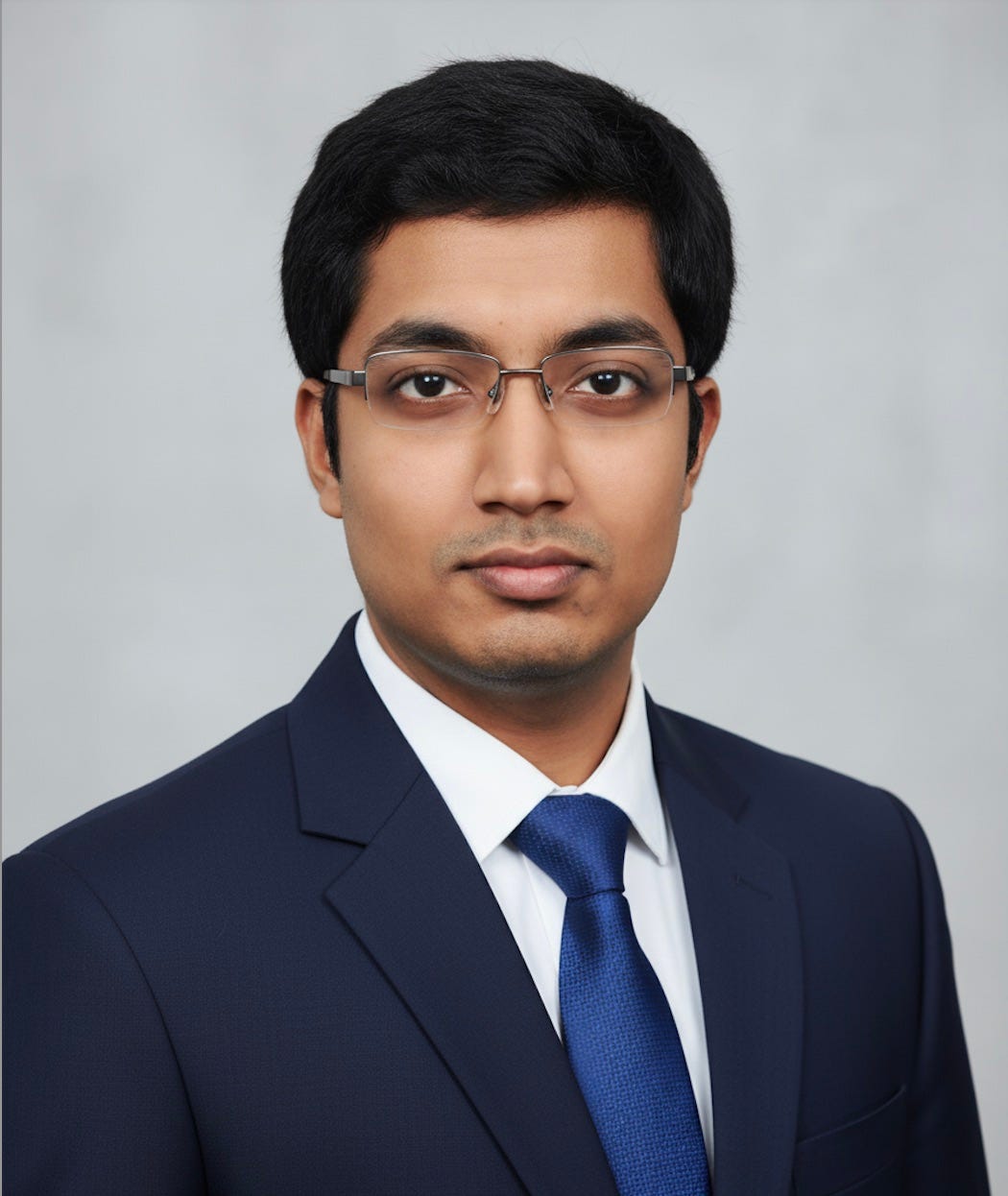
Aravind Balaji at Northeastern
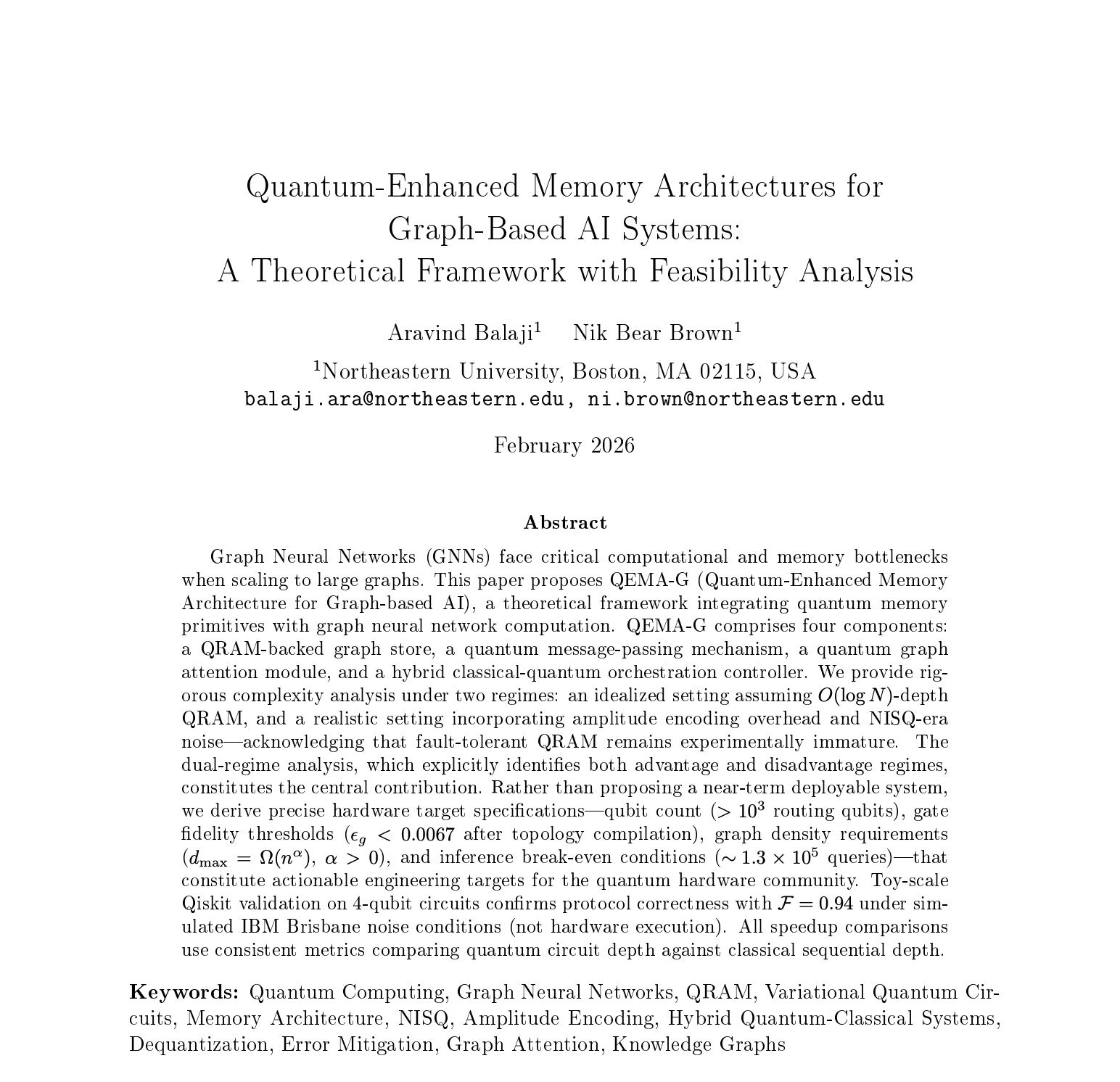
There is a sentence buried on page 2 of Aravind Balaji’s first research publication that stops you cold. After proposing a quantum-enhanced architecture for graph neural networks—a system that could, under the right hardware conditions, eliminate the tail-latency problem that plagues industrial graph AI—he writes, plainly, that fault-tolerant QRAM at the required scale is approximately five to ten years away. He says it again on page 13. And on page 20. And on page 22.
This is not how ambitious first papers usually work. First papers announce arrival. They stake territory. They show what you can do. They do not, typically, repeat their own limitations four times across twenty-six pages, or quantify that their proposed training pipeline is approximately 100,000 times more expensive than classical alternatives, or devote entire sections to identifying the conditions under which their central innovation provides no advantage at all. That is a different kind of intellectual project—one that requires not just ability but a particular form of courage: the willingness to document what you don’t know as precisely as what you do.
Balaji arrived at Northeastern in January 2025 carrying more than most graduate students bring. He had already earned two degrees in India—a Bachelor of Technology in Electronics and Communication Engineering from SRM Institute of Science and Technology, then a Master of Technology in Software Engineering from BITS Pilani, one of India’s most competitive technical institutions—before spending four years building production systems in the Indian healthcare technology sector. He led quality engineering on platforms serving more than 700 clinics. He did not come to Boston to begin his education. He came, at considerable personal expense and without employer sponsorship, because the problems he wanted to work on required a research environment that his prior formation, however substantial, could not yet provide.
That decision—to return to graduate school after years of professional accomplishment, in a different country, in a domain adjacent to but distinct from his existing expertise—is its own kind of data point. It tells you something about what drives the person making it.
The Problem He Chose
Graph Neural Networks have a scaling problem that is architectural rather than implementational. When a GNN processes a hub node—one connected to 15,000 neighbors in a financial transaction graph, say, or a highly cited paper in a citation network—it must touch 15,000 feature vectors, one at a time. Classical pipelines handle median-degree nodes efficiently. They handle hub nodes catastrophically. The result is tail-latency variance: a system where 99 percent of transactions clear in milliseconds and 1 percent spike by orders of magnitude, violating every service-level agreement the system was designed to meet. No classical optimization changes this. The bottleneck is structural.
This was the problem Balaji chose for his first paper. Not a manageable problem at the edge of a well-understood field. A structural problem in a domain—quantum machine learning applied to graph architecture—that required him to simultaneously master quantum information science, graph neural network theory, and the engineering constraints of NISQ-era hardware. He arrived at Northeastern with a software engineering background and no prior quantum computing research experience. The paper was published on TechRxiv in February 2026, his third semester.
The proposed solution—QEMA-G, a four-layer architecture integrating Quantum Random Access Memory with Graph Neural Network computation—works through a quantum adjacency oracle that loads an entire node neighborhood into superposition in O(log n) depth, regardless of degree. A hub node with 15,000 neighbors processes identically to a node with two. The tail-latency problem is not mitigated. It is structurally eliminated.
But here is what makes the paper significant beyond its proposal: Balaji derives this result under two regimes simultaneously. The idealized regime assumes fault-tolerant QRAM and shows exponential advantage—aggregation depth reduces from linear in neighborhood size to logarithmic in graph size. The realistic regime incorporates amplitude encoding overhead, SWAP costs from topology mismatch between bucket-brigade QRAM and IBM’s heavy-hex architecture, and measurement shot requirements. In this regime, advantage narrows: it persists for dense and power-law graphs where maximum degree scales polynomially, and vanishes for sparse regular graphs. Both regimes are derived with equal rigor. Both are reported.
The dual-regime analysis is the paper’s central contribution. Most work in quantum machine learning presents the idealized case. Balaji and his co-author, Prof. Nik Bear Brown, present both—and then go further, providing what they call a practitioner’s decision framework: a table clarifying which speedup metric applies to which operational context, because depth ratio and work ratio can diverge by orders of magnitude and conflating them produces confident nonsense. For fraud detection on a payment processor graph with 10⁸ accounts, the headline depth ratio for hub nodes is 11,400-fold. The operationally relevant metric, accounting for measurement overhead, SWAP costs, and re-encoding, is 5.3-fold. The paper reports both. It explains the difference. It tells you which one to use and why.
What Intellectual Honesty Looks Like Under Pressure
I find myself returning to that training cost number. One hundred thousand times more expensive than classical training. Balaji could have buried this. He could have foregrounded inference economics—where the break-even math is favorable—and relegated training cost to a footnote. Instead, he surfaces it in Section 8, quantifies it precisely, traces it to its causes (the parameter-shift rule’s circuit repetition requirements, the sequential nature of quantum gradient estimation), and then uses it to restructure the paper’s entire contribution. QEMA-G, the analysis concludes, is not a tool for model development. It is a tool for production inference on trained models in latency-critical applications—the specific context where degree-independent processing time has the highest value. The limitation becomes a precision instrument for identifying where the work actually applies.
This same quality appears in his project work, in a different register. During the development of MediGraph AI—a healthcare analytics platform integrating Neo4j knowledge graphs, Snowflake, LangChain, and Graph Data Science algorithms, built within a graduate course’s constraints—Balaji encountered a team situation that required more than technical competence. The project was substantial. The deadline did not move. Rather than reduce scope or seek relief, he absorbed the majority of the technical deliverables while ensuring every team member retained meaningful contribution. He delegated deliberately. He submitted on time. He did not escalate to the instructor. He did not seek individual recognition afterward.
The cost was concrete: lost sleep, compressed time for other coursework, the sustained effort of holding a complex project together under real pressure. He absorbed it because the alternative was a project that didn’t meet the standard it was supposed to meet. That is not a small thing. It is, in fact, the thing that distinguishes people who produce good work from people who produce work that is merely finished.
The Longer Arc
There is a sixteen-year thread running through Balaji’s record that deserves attention precisely because it is easy to overlook. In January 2010—before he entered undergraduate education—he began contributing to Google Maps as a Local Guide. He has continued without interruption to the present, across two countries, accumulating approximately 900 contributions: reviews, photographs, answered questions, verified facts, corrected errors. He has reached Level 7, which requires sustained quality over time, not just volume.
For small businesses without strong digital presence, accurate mapping data determines whether they are discoverable. For travelers navigating unfamiliar cities—particularly in the Global South, where mapping coverage is uneven—a verified photograph or detailed review from a trusted contributor is a practical resource. Balaji has been providing this resource for sixteen years, consistently, without recognition or course credit or institutional facilitation. He began before he knew what research was. He has continued through two degrees, four years of professional work, a transatlantic move, and a second graduate program.
What this reveals is not complicated. It reveals someone for whom contribution is not instrumentally motivated. The work and the doing of it are the same thing.
A Particular Kind of Ambition
Balaji’s Substack—maintained outside any course requirement—traces connections between climate science, AI forecasting, and global infrastructure, synthesizing research from MIT, UPenn, Google DeepMind, and NOAA. He is interested in how Arctic warming destabilizes weather systems across India, Russia, China, Japan, and Europe. He reads across borders because the problems he cares about do not respect them.
In his second semester, he led a five-person team at the MGEN Hackathon 2025 to build an AI-powered MSL Practice Gym in 48 hours—a tool using React, Node.js, and the OpenAI API to simulate real-world medical communication scenarios for healthcare professionals in training. They placed first among all student competitors. The project was not assigned. It was proposed, scoped, built, and delivered under a deadline that left no room for revision.
He carries a 3.87 GPA. He is rebuilding a graduate research club from the ground up—drafting constitutions, navigating bureaucratic reinstatement processes, doing the structural work that no one assigned him because he assessed it needed doing and he was positioned to do it.
None of this is the profile of someone optimizing for the appearance of achievement. It is the profile of someone who has not yet learned to distinguish between what is assigned and what is necessary, and who, in that undifferentiated state, simply does both.
The sentence Balaji wrote four times—that the hardware his system requires is five to ten years away—is not a concession. It is a specification. It tells the engineers who will eventually build that hardware exactly what they need to achieve: more than 1,000 routing qubits, gate fidelity below 0.0067 after topology compilation, binary tree connectivity, coherence time above 50 microseconds. He mapped the distance to something that doesn’t exist yet. That is, in the precise sense of the word, the work.
The biggest lesson from writing QEMA-G, he has said, was learning that documenting where your work breaks matters more than overselling where it shines.
That is not a lesson most people learn in their first paper. It is not a lesson most people learn at all.
Tags: Aravind Balaji, quantum graph neural networks, QEMA-G TechRxiv, Northeastern University graduate research, intellectual honesty in academic writing