Clawd in Walker Jumpman: First Playthrough | CSYE 7270
See Clawd move, jump, fail, retry, pause, and finish in the existing Walker Jumpman level. Liam walks through one focused character change, then shows all 18 animation previews. Built with Brutalist godot-waikthrough walker and riff.
See Clawd move, jump, fail, retry, pause, and finish in the existing Walker Jumpman level. Liam walks through one focused character change, then shows all 18 animation previews. Built with Brutalist godot-waikthrough walker and riff.
Professor Bear is doing Assignment 1 alongside the class. This is iteration one, not a finished assignment: change the main character to Clawd while preserving the starter level and mechanics. Task mini-goals, the final agentic-loop goal, new hazards, and the required level extension come later.
Start early. Make one improvement, inspect it, then make another improvement or test next session. A failed attempt is useful evidence when you record what it ruled out. Keep an honest Frictional log and identify human and AI contributions. Do not invent days of work or tests you never performed.
GAME AND SOURCES Clawd project: https://github.com/nikbearbrown/walker-jumpman-clawd Original starter: https://github.com/nikbearbrown/walker-jumpman Walker: https://github.com/nikbearbrown/walker Brutalist: https://github.com/nikbearbrown/brutalist.art Course playlist: https://www.youtube.com/playlist?list=PLMhsxBEsgHFU AI Policy for Professor Bear's Courses: https://youtu.be/8Ut0Cdl6vMw
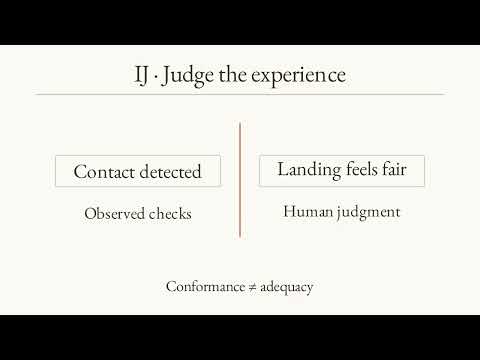
EVIDENCE AND LIMITS Actual Godot output uses scripted normal keyboard and mouse inputs, not a human playtest. Gallery and collision-reference views are labeled diagnostic demonstrations. Replayed footage is identified as the same captured take, not a new test. The wider arms still extend beyond the unchanged collider. Human judgment is needed to decide readability, fairness, and the next revision.
PRODUCTION Liam is an AI narrator using local Kokoro speech synthesis, not a recording or clone of Professor Bear. Suggested Claude prompts and Godot editor reconstructions are labeled. Native 3840 x 2160, 30 fps landscape master, optional English closed captions, no burned-in captions. Regular Brutalist outro. Clawd/Claude are associated with Anthropic; this is an independent educational project, not an official Anthropic or Godot product.
Transcript
A lightly formatted transcript of the video, with timestamps so you can jump to any section on YouTube.
[0:00] Please use Walker to convert my game design document about a coding agent platformer into one small revision. Put Claude in the existing level. Preserve the mechanics. I'm Liam in for Professor Bear. His project is Walker Jumpman Claude. The opening prompt is a suggested handoff, not a saved conversation. We have changed the character, not completed the assignment. Claude now moves through the existing first steps level. The physics and layout remain the starters. A separate gallery contains 18 animations, task mini goals, new hazards, and the required level extension or later decisions. This is the first revision of a semester long example. Predict what might break, build one change, play it, inspect the
[0:40] Evidence, revise, then record the version. Here, the prediction is specific. Claude's wide arms might make the unchanged collision box misleading. A small experiment gives us a question to answer. Changing the character level and physics together would make that answer harder to isolate. Here is the actual god dot level. Enter starts, left and right move, and the character stops after release. Claude's legs now animate with movement. The ground and controls have not been redesigned. These are scripted normal input captures, not Professor Bear's play test. The first visual question is simple. Can you read this character at game size? Watch the feet leave the ground and return.
[1:16] Holding space does not bounce again on landing, and another press in the air does not create a double jump. The airborne drawing holds a pose while physics supplies the trajectory. An animation named jump must not secretly add another movement mechanic. This enlarged view uses the actual god dot drawing routine. The blue rectangle marks the unchanged 18x28 collision reference. Claude's arms extend beyond it. That is a real first pass trade-off, not a solved design problem. Bear should test whether the mismatch feels forgiving or confusing before deciding on a second change into the spikes failure. for a brief error animation, one retry, then control returns at the
[1:53] Start. We did not invent a new hazard system. The character's reaction is presentation while the session still owns the reset. Watch the result before deciding whether that visual reaction explains enough. Missing the gap still ends the attempt and starts another. This is not the same test as touching spikes. Both need checking after a visual change because a new silhouette can change what a landing appears to mean. The observed retry works. Whether the failure reads clearly is still a human judgment. Here the jump input arrives just after leaving a ledge and the character still rises. This is the starter coyote window, not a new clawed power. The recording demonstrates this
[2:31] Particular late jump. Boundary tests separately check the accepted and expired tick ages. One attractive replay does not prove every timing case. Now space arrives before landing and the buffered request produces the next jump. The controller consumes that request once. This is different from holding a key forever. Keeping the original input behavior gives us a stable baseline while we inspect the new character. The art is the experiment. The jump rules are not. Escape pauses the jump. Enter resumes and R restarts. The capture also sends a labeled simulated focus loss event, returns to the menu, and starts again. Pause freezes the animation clock as well as the player's motion. These
[3:09] Scripted checks demonstrate the recorded controls, not an unstated human usability test. The menus button also resumes and starts the game with mouse input. It is easy to check only the keyboard path you usually use. A small revision deserves a small but deliberate regression pass. Does the rest of the existing interface still do what it did before? Claude clears the original steps and gaps, reaches the same finish, and celebrates. Enter starts a fresh run. This recorded route completes without a death. It is not yet the proposed agent game. The flag is still the original flag. Keeping that distinction visible is part of explaining what we actually
[3:46] Built. A first scene can appear quickly. Refinement is where the work continues. Make an improvement today. Come back for another improvement or test in the next session. If an attempt does not work, record what you tried, observed, and learned in frictional. Do not manufacture, struggle, or pretend these changes happened across several days. This iteration's entries are from one actual session. Bear's longerterm idea is a coding agent crossing mini goals. A task completed, another task checked, and eventually a full agentic loop finished. Those are design notes, not features in today's build. The level extension is still required for assignment one. Starting with Claude's appearance lets Bear decide the next
[4:23] Step from something he can actually play. Idle, bounce, wave, look, walk, and run. Watch the four legs alternate in the eyes scan. These are actual god gallery previews of the ported library. Bounce and wave are available artwork, not player commands in this level. The gallery lets us judge options before choosing more behavior. Think type, sleep, error, nod, and shake. Their names suggest possible future coding agent moments, but naming an animation does not implement a task system. Error currently reacts to failure. The others remain catalog options. Choose a future state for a reason. Then test whether the animation communicates it. Dance, stretch, crouch, jump, spin, and
[5:02] Celebrate. Spin flips horizontally instead of rotating the pixel rectangles. The gallery jump is decorative. Gameplay uses its held pose while physics moves the body. Celebrate is connected to the current finish. All 18 are here to inspect, not a promise of 18 powers. The verdict. One recognizable character change, preserved mechanics, and a visible question about collision. The I wrote and tested the implementation. Bear supplied the intent and chooses what deserves another iteration. Start early enough to inspect the result. A test that reveals a problem can move the project forward without making the feature complete. Your turn. Please inspect Walker Jumpman Claude. Propose one visual improvement and one test. Preserve the mechanics and
[5:43] Log the result in frictional. Before accepting the change, check that it answers a specific observation, leaves the existing controls intact, and names what the test does not establish. Then let a human play. Liam in for Professor Bear. >> Nick Bear Brown Teaching Club. >> >> Big bear brown.
More from CSYE 7270 Virtual Environments and Real-Time 3D
 7:42
7:42Building Clawd: Code to Gameplay, One Change at a Time | CSYE 7270
 1:08
1:08My Email Policy (Professor Bear)
 4:29
4:29Godot Walkthrough Skill | Turn Gameplay into an Explainer
 10:04
10:04CSYE 7270: Virtual Environments and Real-Time 3D
 3:45
3:45Godot Game-Development Skill | Explain Code, Components, and Art
 13:26
13:26