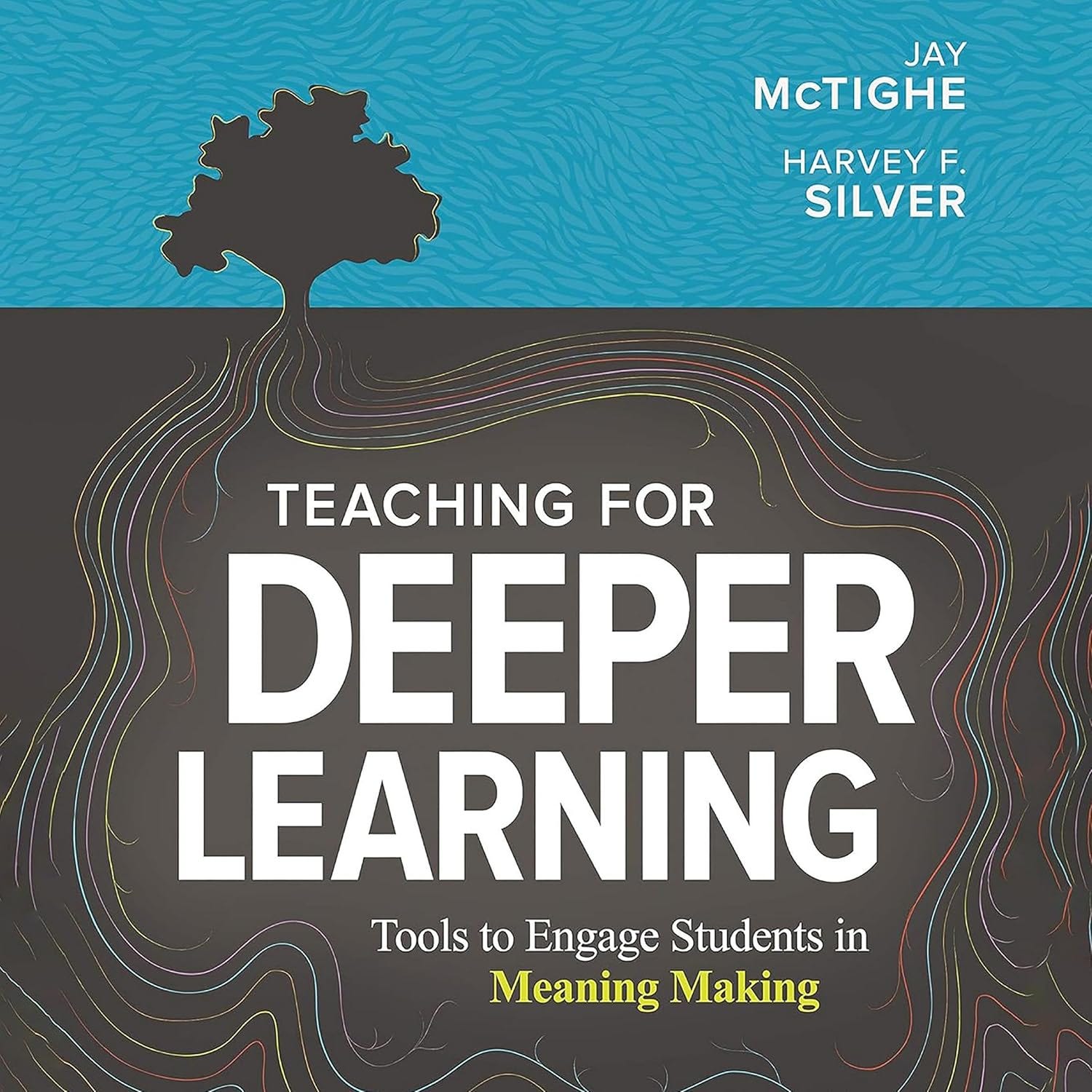
Teaching for Deeper Learning: Tools to Engage Students in Meaning Making
Jay McTighe & Harvey F. Silver (2020) | ASCD
PART 1: SECTION-BY-SECTION LOGICAL MAPPING
PREFACE & INTRODUCTION: The Case for Meaning-Making
Core Claim: Current schooling over-emphasizes knowledge transmission; what students actually need is active meaning-making via seven specific thinking skills that will produce deep, transferable understanding.
Supporting Evidence:
Reference to Buckminster Fuller’s four design questions as organizing frame for the book’s purpose
“Inert knowledge” construct (National Research Council, 2000): learning that is superficially acquired, never truly understood, and quickly forgotten
Claim that the seven skills “separate high achievers from their average or low performing peers”
Seven skills identified: conceptualizing; notemaking and summarizing; comparing; reading for understanding; predicting and hypothesizing; visualizing and graphic representation; perspective-taking and empathizing
Logical Method: Framing argument: establish what is wrong with current practice (coverage model → inert knowledge), introduce the alternative (meaning-making), then justify the specific selection of seven skills.
Logical Gaps:
The assertion that these seven skills “separate high achievers from low performers” is stated as the authors’ experiential observation, not referenced to any specific study or data source. The causal direction is ambiguous: high achievers may deploy these skills because they are already skilled learners, not because the skills caused their achievement.
“Seven is a manageable number” is offered as a pedagogical rationale, not an empirical one. No evidence that seven is better than five or twelve for implementation purposes.
The introduction uses “deep learning” and “meaning-making” interchangeably and does not formally define either term before building on them. The definitional work is implicit rather than explicit.
The claim that understanding “must be earned” (i.e., cannot be transmitted) is a theoretical commitment drawn from constructivist learning theory but is not attributed to any specific research program.
Methodological Soundness: The introduction functions as advocacy framing. Claims about the skills’ importance should be treated as hypotheses the subsequent chapters attempt to support, not established facts. The book’s framework is coherent but is a practitioner synthesis, not a systematic review of evidence.
CHAPTER 1: Framing Learning Around Big Ideas
Core Claim: Modern curriculum should be organized around a smaller number of conceptually large, transferable ideas rather than exhaustive factual coverage, because knowledge is expanding too fast to cover comprehensively and transfer requires conceptual rather than factual understanding.
Supporting Evidence:
Knowledge doubling times now measured in months, not decades — asserted but not cited to a specific source
Constructivist alignment with NRC 2000: expert knowledge organized around core concepts, not lists of facts
US standards alignment: Common Core, NGSS, C3 Framework all emphasize conceptual understanding over coverage
Three framing tools described with implementation examples: “A Study In,” Concept Word Wall, Essential Questions
Logical Method: Four-premise argument: (1) too much content exists to cover; (2) coverage produces shallow learning; (3) expert knowledge is conceptually organized; (4) transfer requires conceptual understanding. Therefore: organize curriculum around concepts.
Logical Gaps:
The recommendation to reduce content in favor of depth is well-theorized but the authors do not address the political and accountability constraints that make this difficult — standardized tests covering specific content, pacing guides, content-heavy syllabi. The prescriptive advice is theoretically sound but practically underspecified.
“A Study In” framing is presented with illustrative examples (impressionism as “a study in revolution”) but without evidence that this framing technique, specifically, improves student understanding compared to conventional topic framing. The logic is plausible but empirical validation is not provided.
Essential questions are presented with a rich literature base (Wiggins & McTighe 2005, 2011, 2012) but the causal claim — that EQs specifically improve transfer — is not separated from other elements of Understanding by Design implementation.
Methodological Soundness: Adequate as theoretical argumentation. The chapter is a well-organized practitioner synthesis. Claims should be treated as theoretically grounded recommendations, not empirically validated prescriptions.
CHAPTER 2: Conceptualizing
Core Claim: Students must learn to move from facts to concepts through active inductive reasoning; because this process is natural but often not consciously deployable on demand, structured tools can scaffold it explicitly.
Supporting Evidence:
Jerome Bruner (1973) as foundation for concept attainment approach
Five tools described with classroom examples: concept attainment, concept definition map, “A Study In” (student version), adding up the facts, connect the concepts
Example of concept attainment lesson: teacher reveals “predator” concept through yes/no animal classification
Blackberry corporate failure used as cross-domain transfer example for organism-environment-adaptation generalization
Logical Method: The “natural but not consciously deployable” argument: because conceptualizing is tacit in everyday cognition, students need explicit scaffolding to apply it to academic content. Tools make the implicit process explicit.
Logical Gaps:
The cross-domain transfer example (Blackberry failing to adapt to iOS/Android compared to an organism failing to adapt to environmental change) is presented as evidence that teaching the biological concept supports business analysis. This conflates illustrative analogy with empirical transfer. No evidence is provided that students who learned the adaptation generalization via the Add Up the Facts tool could actually apply it to analyze business competition.
Concept attainment through yes/no sorting is attributed to Bruner (1973) — a 50-year-old foundational reference. The chapter does not engage with subsequent research on concept learning or whether the specific yes/no inductive format outperforms other approaches.
“Connect the Concepts” tool claims to teach students to form generalizations that are “transferable across examples and contexts” but the evidence offered is entirely illustrative. No data on whether students who used the tool demonstrated superior transfer compared to students who did not.
Methodological Soundness: Adequate as pedagogical design. The tools are logically well-constructed and grounded in established constructivist theory. Effectiveness claims should be understood as inference from theoretical principles, not documented outcomes.
CHAPTER 3: Notemaking and Summarizing
Core Claim: Notemaking (not note-taking) and summarizing are active meaning-making processes that improve retention and comprehension; they can and should be directly taught using structured tools.
Supporting Evidence:
Meta-analytic citation: Beasley and Abthorpe (2010) on positive effects of summarizing and notemaking across grade levels and content areas
Additional citations: Boyle (2013); Guido and Colwell (1987); Ramani and Sadegi (2011)
Six tools described: window notes, math notes, interactive notemaking (SQ3R variant), webbing, 4-2-1 summarize, AWESOME acronym
Logical Method: Establishes the value of the skills empirically, then introduces tools that scaffold them by addressing specific instructional problems (verbatim copying, failure to identify main idea, synthesis failure).
Logical Gaps:
The distinction between “note-taking” (copying) and “notemaking” (constructing) is central to the chapter’s argument but the meta-analytic citations are for the general category, not for the specific windowed or structured formats presented. Whether window notes specifically outperform conventional notes is not established.
The SQ3R foundation for interactive notemaking is a well-validated reading strategy (Robinson, 1946), but the chapter’s specific implementation adds a four-column monitoring system without citing evidence specific to that modification.
The 4-2-1 Summarize tool is described as producing better main idea identification than asking students to directly state the main idea. The logic is compelling (bottom-up distillation vs. top-down identification), but no comparative study is cited.
Methodological Soundness: This chapter has the strongest external evidence base of any in the book. The meta-analytic citations ground the general claims. Tool-specific effectiveness remains theoretically inferred rather than empirically demonstrated.
CHAPTER 4: Comparing
Core Claim: Comparing is the highest-impact thinking skill for raising achievement; but in practice it fails because of identifiable pitfalls (premature comparison, trivial criteria, no conclusions drawn), which specific tools can systematically address.
Supporting Evidence:
Meta-analyses cited: Dean, Hubble, Pitler and Stone (2012); Marzano, Pickering and Pollock (2001) — teaching comparing and contrasting leads to significant achievement gains
Transfer claim: Tiantoni Hu (2016) on comparative thinking and transfer
Six tools mapped to six specific pitfalls: describe first/compare second; meaningful criteria; T-chart/comparison matrix; “What can you conclude?”; compare-and-conclude matrix; community circle
Logical Method: Research anchor (effect size evidence) → problem identification (six common pitfalls) → targeted tool design (each tool addresses a named pitfall). This is the most tightly structured chapter in the book.
Logical Gaps:
The meta-analytic evidence is for “comparing and contrasting” as a broad pedagogical strategy, not for the specific tools described. Whether using a T-chart versus a Venn diagram specifically, or adding the “What can you conclude?” step specifically, produces the achievement gains documented in the meta-analyses is not established.
The community circle tool, which uses comparison to structure classroom discussion, is attributed to Silver, Perini and Boots (2016) but no effectiveness data is cited for it. It is a design product, not a researched intervention.
The recommendation to use the T-chart over the Venn diagram rests on a structural argument (more room for differences, side-by-side parallelism) rather than comparative research on organizer effectiveness.
Methodological Soundness: The external evidence base for comparative thinking broadly is the book’s strongest. The chapter correctly distinguishes between the strategy (supported by meta-analyses) and the specific tools (theoretical design). The argument is logically sound.
CHAPTER 5: Reading for Understanding
Core Claim: Proficient reading is a three-phase process (before, during, after); most students skip phases 1 and 3; teaching students explicit strategies for all three phases substantially improves comprehension.
Supporting Evidence:
Pressley (2006): proficient reading involves conscious processing that begins before reading and persists after completion
Three-phase framework grounded in SQ3R tradition (Robinson, 1946)
Five tools: power previewing, scavenger hunt, single sentence summaries, reading stances (Langer, 1994), reading for meaning
Logical Method: Descriptive model (three phases of proficient reading) → diagnosis (students skip phases) → targeted tools (one or more tools per phase).
Logical Gaps:
Reading stances are attributed to Langer (1994) and include four categories: literal, interpretive, personal, critical. The personal stance (”how do I feel about this?”) is included as a reading comprehension tool, but the relationship between personal affect and comprehension outcomes is not established. The inclusion is theoretically motivated (engagement → motivation → comprehension) but the chain is inferential.
The “reading for meaning” tool uses teacher-designed statements (true/false/contested) before reading to activate prediction and guide search during reading. This is a well-established anticipation guide format, but the specific claim that it produces deeper understanding compared to reading with guiding questions or without pre-reading scaffolds is not tested.
Power previewing’s five P’s (Probe, Pencil, Prior knowledge, Personalize, Predict) are presented as a teachable sequence but no study comparing students taught this sequence to students using other previewing strategies is cited.
Methodological Soundness: Adequate. The three-phase model of proficient reading is well-grounded in reading research. Tool-specific effectiveness is theoretically inferred. The chapter appropriately bases tool design on documented characteristics of proficient readers.
CHAPTER 6: Predicting and Hypothesizing
Core Claim: Predicting and hypothesizing are distinct but related skills — prediction forecasts outcomes, hypothesizing proposes explanations — both improve engagement, focus, and ultimately learning; they can be taught across all content areas, not just science.
Supporting Evidence:
Judy Willis (neurologist-turned-teacher): prediction guided by pattern recognition is a foundational problem-solving strategy for literacy, numeracy, and test-taking
Dean et al. (2012): hypothesizing is an effective strategy for boosting achievement
Hilda Taba’s foundational work (Durkin, Franco and McNaughton, 1971) as basis for inductive learning approach
Four tools: prediction/hypothesis hooks, inductive learning, mystery, if/then
Logical Method: Conceptual distinction (prediction vs. hypothesis) → theoretical grounding (pattern recognition and causal reasoning) → cross-disciplinary application argument → tool design.
Logical Gaps:
Willis’s claim about prediction is cited as the perspective of “a board certified neurologist” who became a teacher — an authority argument rather than a citation to specific neuroscience research supporting the pedagogical application.
The inductive learning tool is attributed to Taba (foundational mid-20th century work) without engaging with subsequent research on inductive vs. deductive instruction. Whether inductive learning of concepts produces better transfer than deductive instruction (define concept, give examples) is an empirical question not addressed.
The “mystery” format — presenting content as a puzzle to be solved with clues — is described as making hypothesizing engaging, but engagement and learning are distinguished as separate constructs throughout this review. Whether mystery engagement transfers to retention or transfer of content is not established. This is the engagement-learning conflation: a recurring issue in educational technology and pedagogy books.
Methodological Soundness: Adequate as pedagogical design. The distinction between predicting and hypothesizing is genuinely useful and underexplored in practice. The chapter correctly notes that hypothesizing should be applied across disciplines, not just in science. Effect size claims for hypothesizing are supported by Dean et al. (2012) for the general strategy.
CHAPTER 7: Visualizing and Graphic Representation
Core Claim: The brain’s natural orientation toward visual-spatial processing means that visual representation — both imagery and graphic organizers — substantially enhances meaning-making, retention, and understanding.
Supporting Evidence:
Medina (2008): visual processing is the brain’s preferred mode; more visual input = better recognition and recall
Paivio (1990): dual coding theory — verbal and visual channels working together increase learning more than either alone
Meta-analytic support: Beasley and Abthorpe (2010); Dean et al. (2012) — significant positive effects of non-linguistic representation on achievement
Five tools: don’t just say it/display it; split screen; mind’s eye; visualizing vocabulary; graphic organizers (advanced organizer, story map, concept map, student-generated visual organizers)
Logical Method: Neuroscientific grounding (visual processing primacy) → cognitive science grounding (dual coding) → meta-analytic support → tool design addressing specific learning purposes.
Logical Gaps:
Dual coding theory (Paivio, 1990) has robust experimental support for paired associate learning but its application to complex disciplinary content (concept maps, story maps, split-screen notes) involves a significant extrapolation. The theory is typically tested in controlled memory experiments, not in naturalistic classroom learning across subjects.
The recommendation for concept maps is grounded in NRC 2000 research on expert knowledge organization. However, concept mapping is a complex skill — research suggests that unskilled concept mappers often produce maps that do not reflect their actual understanding and that map quality is difficult to assess. This limitation is not addressed.
“Mind’s eye” (creating mental images before reading) is a well-known comprehension strategy attributed to Wilhelm (2012) and Pressley (1979). The chapter does not note that visualization benefits are domain-specific: strong for narrative and concrete texts, much weaker for abstract or procedural texts (e.g., reading for understanding of mathematical proofs).
Methodological Soundness: The general claim (visual representation improves learning) has solid empirical support. Tool-specific effectiveness, and the conditions under which each tool works best, are underspecified.
CHAPTER 8: Perspective-Taking and Empathizing
Core Claim: Perspective-taking (analytical, critical distance from default viewpoint) and empathizing (affective resonance with others’ experience) are distinct but complementary meaning-making skills; they can be taught across content areas and are essential for both academic achievement and social-emotional development.
Supporting Evidence:
Wiggins and McTighe (2005): perspective is one of six facets of understanding — characterized by discipline of asking “how does it look from another point of view?”
CASEL (Collaborative for Academic, Social, and Emotional Learning, 2017): perspective-taking and empathy identified as one of five core social-emotional competencies
Bradley Commission on History in Schools (1988): empathy as a primary aim of history education
Five tools: questioning prompts, “put the you in the content,” perspective chart, meeting of the minds/mock trial, “a day in the life”
Logical Method: Conceptual distinction (perspective = analytical; empathy = affective) → curricular rationale across subject areas → tool design for each construct.
Logical Gaps:
The chapter introduces empathy as a meaning-making skill for all content areas, but the examples are overwhelmingly from history, literature, and social studies. The STEM applications described in Figure 8.1 (e.g., “consider the ethics of AI from multiple perspectives”) are perspective-based, not empathy-based — a conflation the chapter itself acknowledges conceptually but does not resolve in its tools.
“A day in the life” — asking students to write from the perspective of a concept, object, or person they are studying — is presented as building empathetic understanding. Writing from an object’s perspective (a white blood cell, a chrysalis) is more accurately a perspective exercise requiring inferential reasoning than an empathy exercise. Labeling it “empathy” overstates the cognitive-emotional claim.
The mock trial and meeting of the minds are described as effective tools but without evidence distinguishing role-play learning from equivalent time spent in other instructional formats. Research on role-play in education is mixed, particularly regarding retention of content versus engagement.
Methodological Soundness: Adequate as pedagogical design. The conceptual distinction between perspective and empathy is genuinely valuable. The tools are coherent designs. Effectiveness evidence is thin — the chapter leans on theoretical and normative arguments (what education should aim for) rather than empirical claims.
CHAPTER 9: Putting It All Together
Core Claim: The seven skills and their associated tools should be integrated across an entire year of curriculum through a deliberate instructional design framework (five episodes) and a curriculum mapping matrix that aligns content to both big ideas and thinking skills.
Supporting Evidence:
Five-episode instructional framework: (1) prepare for new learning; (2) present new learning; (3) deepen and reinforce; (4) apply and demonstrate; (5) reflect and celebrate — attributed to Silver Strong and Associates (2013) and grounded in Hunter (1984), Marzano (2007), Wiggins and McTighe (2005)
Curriculum mapping matrix illustrated for American History course (1890-present): topic, “study in” concept, essential questions, thinking skills, tools
Goodwin, Gibson, Lewis and Rulo (2018) cited for research on how learners develop deep understanding
Logical Method: Synthesis chapter — takes all prior components (big idea framing, seven skills, tools) and provides a practical architecture for integration at lesson, unit, and year-long levels.
Logical Gaps:
The five-episode framework is presented as a research-grounded design, but the cited foundations (Hunter, 1984; Marzano, 2007; Wiggins and McTighe, 2005) represent distinct theoretical traditions that are synthesized here without analysis of tensions between them. Hunter’s Mastery Teaching model is behaviorally-oriented; Wiggins and McTighe’s backward design is outcomes-oriented; Marzano’s classroom instruction research is meta-analytically grounded. The synthesis is pragmatic but potentially eclectic.
The curriculum mapping matrix example is illustrative, not empirical. No data is provided comparing student outcomes in courses that used the matrix systematically versus courses that did not.
The chapter’s claim that systematic use of the seven skills over a full year builds student proficiency sufficient for independent transfer is the book’s most significant practical prediction — and the least empirically supported. Transfer of thinking skills is notoriously difficult to achieve and measure.
Methodological Soundness: Adequate as instructional design guidance. The five-episode framework and curriculum mapping matrix are professionally sound tools. Their effectiveness relative to other planning frameworks is not established.
BRIDGE: Synthesizing the Logical Architecture
The book’s argumentative structure is layered but consistent. The outer layer is normative: schools should prioritize deep understanding over coverage because the world has changed. The inner layer is practical: here are seven skills and associated tools that reliably develop that understanding. The challenge is that the two layers rest on different kinds of evidence.
Three recurring tensions across all nine chapters:
Tension 1: Engagement vs. Learning. The book recurrently treats student engagement as evidence of learning, or treats tools that produce engagement as evidence that they produce deep understanding. The “mystery” format is engaging. The “day in the life” is engaging. Role-play is engaging. Whether these engagement-producing formats produce superior retention, comprehension, or transfer compared to less engaging alternatives is consistently assumed rather than demonstrated. This is the central methodological limitation of the practitioner-synthesis genre: enthusiasm for a tool, and observation that students respond positively to it, is not the same as evidence that it produces the intended cognitive outcomes.
Tension 2: Theoretically grounded vs. empirically validated. The book is well-grounded in foundational theory — Bruner on concept attainment, NRC 2000 on expert knowledge organization, Paivio on dual coding, Vygotsky’s constructivism implicitly throughout. But foundational theory does not validate specific implementations. Dual coding theory does not validate concept maps specifically. Constructivist learning theory does not validate the 4-2-1 summarize protocol specifically. The gap between theoretical framework and tool-level effectiveness is not acknowledged.
Tension 3: Universal claim vs. conditional evidence. The book recommends its seven skills and tools as applicable to “all grade levels and content areas.” Some of this generality is plausible — comparing is genuinely a high-impact strategy across domains. But visualization benefits documented in controlled studies are stronger for narrative than abstract content; empathy tools are naturally at home in history and literature but stretch significantly for STEM; predicting works differently in reading comprehension (anticipation guides) than in scientific hypothesis generation. The universality claim is partly rhetorical.
The book’s most proven claims:
Meta-analytic evidence supports comparative thinking as a high-impact strategy for achievement
Meta-analytic evidence supports notemaking/summarizing broadly
Three-phase reading comprehension model (before/during/after) is well-grounded in reading research
Organizing curriculum around big ideas and essential questions has strong theoretical and practitioner evidence
The book’s most significant unproven claims:
That the seven specific tools described produce the achievement gains attributable to the broader strategies they instantiate
That engagement with the tools translates into transfer of the embedded thinking skills to independent use
That the tools work equivalently across all content areas and grade levels
The book’s most significant acknowledged gaps:
The political and structural constraints on implementing concept-based curriculum at scale
The substantial time required to develop metacognitive independence with any of the seven skills
What happens when tools fail — the book is almost entirely success-case oriented
PART 2: LITERARY REVIEW ESSAY
The Toolkit Problem
There is an old tension at the center of educational design that Jay McTighe and Harvey Silver have been navigating together and separately for most of their careers: the tension between what teachers need right now and what would actually help students most. These are not the same thing. What teachers need right now is something they can use Monday morning. What would help students most is a transformed understanding of what learning is for. Teaching for Deeper Learning: Tools to Engage Students in Meaning Making (ASCD, 2020) attempts to deliver both. It mostly delivers the first, and gestures usefully at the second.
The ambition is real. McTighe is the architect of Understanding by Design, one of the most influential curriculum frameworks of the past thirty years. Silver leads the Thoughtful Classroom project, a practitioner-research program with deep roots in classroom implementation. Their collaboration here is genuine: this book synthesizes McTighe’s insistence on conceptual framing (”big ideas,” “essential questions,” “backward design”) with Silver’s arsenal of practical thinking-skill tools. The synthesis is coherent and the tools are well-designed. The book’s problem is not what it says but what it cannot say within its chosen form.
The central claim is compact: deep learning requires active meaning-making; meaning-making requires seven specific thinking skills; those skills can be taught using structured tools. The seven skills — conceptualizing, notemaking and summarizing, comparing, reading for understanding, predicting and hypothesizing, visualizing and graphic representation, perspective-taking and empathizing — are presented as both the means by which students develop understanding and the ends that constitute transferable intellectual competence. The dual role is important. The tools serve the content; and they serve the student beyond the content.
Two of the seven skills carry robust external validation. Comparative thinking — the book’s fourth chapter — benefits from substantial meta-analytic support. Dean, Hubble, Pitler and Stone (2012) and Marzano, Pickering and Pollock (2001) document significant achievement gains from explicit instruction in comparing and contrasting. Notemaking and summarizing (Chapter 3) similarly draw on a multi-study evidence base. These two chapters earn the most credibility because the authors correctly distinguish between the general strategy (supported by meta-analysis) and their specific tools (theoretically grounded, classroom-tested, but not independently evaluated). That distinction — between what the research shows and what follows from it — is methodologically honest, and unfortunately rare.
The other five chapters work differently. Visualization benefits from dual coding theory (Paivio, 1990) and brain research on visual processing primacy (Medina, 2008) — solid foundations that support the general claim but do not validate any specific organizer format. Reading for understanding is grounded in Pressley’s (2006) three-phase model of proficient reading, which is well-established, but the specific five-P previewing sequence and the windowed organizer formats derive from practitioner design, not controlled study. Predicting and hypothesizing cites Dean et al. (2012) for achievement effects, then bases tool design on Taba’s mid-century inductive learning work without engaging decades of subsequent research on inductive vs. deductive instruction. Perspective-taking and empathizing has the thinnest empirical base of the seven — its rationale is primarily normative (what education should achieve) and the tools are creative designs with no cited outcome data.
I am not raising this to dismiss the work. Practitioner synthesis is a legitimate and important genre. The problem arises when the book treats all seven skills as equivalently validated. They are not. Comparing has different evidentiary support than perspective-taking. The toolkit structure — seven skills, roughly equal treatment, similar confidence level across — obscures a gradient that matters for practitioners deciding where to invest instructional time.
The book’s deepest unresolved problem is what I will call the engagement-learning conflation. It appears in almost every chapter, sometimes flagged, more often invisible.
The mystery format (Chapter 6) makes hypothesizing engaging by presenting content as a puzzle. Students receive clues, group them, generate hypotheses, and check against sources. This is pedagogically appealing. The book presents it as evidence that hypothesizing can be taught and students enjoy it. What it does not establish is whether the mystery format produces better retention, comprehension, or transfer of the content being studied than equivalent time spent in other formats — say, direct instruction followed by application, or reading with discussion questions. Engagement is real. Engagement as a proxy for learning is a logical leap.
The same pattern appears with “a day in the life” (Chapter 8), which asks students to write from the perspective of a concept, a historical figure, or even an object (a white blood cell, a chrysalis). The examples are vivid and students produce interesting work. Whether that work reflects deeper understanding of the concept being studied — or merely creative engagement with a familiar literary convention — is not established. A student who writes a first-person account of a white blood cell’s hunt for a virus may have learned more about narrative voice than about immunology.
This is not a trivial criticism. The book’s audience consists largely of teachers who are trying to make classroom time productive, not merely engaging. If a tool produces engagement without learning, it has an opportunity cost: the time spent on the engaging activity is time not spent on something that might have produced both. The book’s almost universal positivity about its own tools — there are essentially no examples of a tool failing or producing unintended outcomes — means that practitioners cannot calibrate risk.
The one exception to this pattern is Chapter 7’s honest acknowledgment that students need direct instruction in how to use graphic organizers before they become effective thinking tools. “Show students how you use this tool” appears repeatedly and appropriately. The pedagogical realism of that section — organizers can become mechanical exercises if not taught carefully — is the book’s most trustworthy moment.
The strongest section of the book is Chapter 1, not because it contains the most evidence, but because it frames the right question. The curriculum design argument — that knowledge is expanding too fast to cover, that expertise is organized around concepts not facts, that transfer requires conceptual understanding — is well-grounded and genuinely important. McTighe has been making this argument for thirty years and it has not become less true. The practical tools for big-idea framing (A Study In, Concept Word Wall, Essential Questions) are among the most immediately implementable in the book, and the examples are genuinely clarifying.
The chapter does not address why, given decades of advocacy for concept-based curriculum, most classrooms continue to operate on a coverage model. The structural answer — high-stakes tests measuring factual recall, pacing guides set to cover state standards, content-dense syllabi — is the book’s most significant omission. Teaching for Deeper Learning is written for teachers who have freedom to redesign their curriculum around big ideas. For the majority of teachers in accountability-heavy environments, that freedom is substantially constrained. The book’s ambition reaches past its deployment context.
Where does this leave a reader — a teacher, an instructional coach, a curriculum designer?
The honest answer is: with genuinely useful tools and a framework that is more theoretical than empirical, more inspirational than operational. For teachers who have never thought systematically about the distinction between note-taking and notemaking, or who have used Venn diagrams for all comparisons without considering whether they support the conclusions students are supposed to draw, this book offers concrete improvements. The window notes format is a better design than conventional copying. The T-chart is structurally superior to the Venn diagram for most comparison purposes. The four-reading-stances model gives teachers a richer vocabulary for asking students to engage with texts. These are real contributions to classroom practice.
What the book cannot deliver — and does not claim to deliver, to its credit — is proof that the whole system works. It cannot show that students taught by teachers who implement all seven skills across a full year with a curriculum mapping matrix produce significantly better transfer outcomes than students taught by teachers who do not. That study does not exist. The honest framing — “here is a theoretically grounded, practitioner-tested design system whose effects at scale are not yet established” — is accurate, and the book mostly honors it.
The toolkit problem, finally, is this: a good toolkit can be used well or badly. A hammer does not build a house; a carpenter does. The book provides the tools and, to its genuine credit, extensive guidance on how to use them. What it cannot provide is the practitioner judgment required to know which tool to reach for when, at what depth, for which students, in which content area. That judgment develops through deliberate practice and feedback — the very kind of active meaning-making the book recommends for students. The deepest implication of Teaching for Deeper Learning may be that the same principles it advocates for students apply equally to the teachers who are supposed to enact them. If understanding must be earned through active construction, then no book, however well-designed, can shortcut that process.
Tags: Teaching for Deeper Learning McTighe Silver, meaning-making pedagogy deep learning, big ideas curriculum design essential questions, thinking skills instructional tools classroom, engagement learning conflation educational research gap