Teach Game-AI Verification with Three Runnable Exercises | Assignment 9
Teach a game-AI development technique by separating state checks, rendered evidence and human judgment.
Teach a game-AI development technique by separating state checks, rendered evidence and human judgment.
A read-only observer, native game captures and three runnable starter/solution exercises show why a passing test can still support the wrong claim. Compare a declared shader interface, actual state-to-uniform behavior and independent pixel evidence. The exercises have recorded failures and passes; teaching effectiveness has not been established by a learner tryout.
CSYE 7270, Assignment 9: Professor Bear’s worked example.
Your turn Read my teaching starter and solution. Map each objective to an exercise and a check. Confirm that the starter parses but fails the intended assertions, and the solution passes. Identify which claims need native frames and which need an actual learner. Do not invent a tryout or personal reflection.
Chapters 0:00 Introduction 0:38 Explain The Technique 1:31 Show The Real Instruments 3:51 Try The Three Exercises 5:10 Teach And Hand Off Honestly 6:06 Closing
Sources and credits CSYE 7270 assignment brief; Walker Claude source, design records, test receipts and engine captures. Teaching direction: Nik Bear Brown. AI-assisted implementation, analysis and film production. Liam, in for Bear: synthetic Kokoro narration. Scripted engine input is labeled; no human playtest or learner approval is claimed.
Professor Bear Does His Assignments https://www.youtube.com/playlist?list=PLM51lFDKue_A
What this video covers
- 0:00 — Introduction
- 0:38 — Explain The Technique
- 1:31 — Show The Real Instruments
- 3:51 — Try The Three Exercises
- 5:10 — Teach And Hand Off Honestly
- 6:06 — Closing
Transcript
A lightly formatted transcript of the video, with timestamps so you can jump to any section on YouTube.
Introduction
[0:00] CSY7270 assignment walkthroughs teach a verification loop. Explain the evidence, show the real game, and build exercises that reveal mistakes. Hello, this is Liam in Forbear. For CSY7270, we teach an AI assisted development technique. Choose evidence that can actually support the claim. Walker Claude supplies the real game, a diagnostic observer, and three small exercises. Prerequisite terms contract the declared interface and required behavior probe an instrument that observes a value fixture a controlled test setup oracle an independent expected result. This
Explain The Technique
[0:39] Assignment permits AI assisted development techniques not only game agent algorithms. Our technique connects a declared interface real gameplay state native pixels and the human judgment that neither machine check can supply. The learner can run a go test and read a shader. Three objectives mapped to exercises. Inspect the declared uniform, normalize a real event, and limit a claim to the evidence. Teaching starts with that mapping. The observer is attached to the actual signal garden room. V toggles it. It reads charge and the pad uniform without controlling movement, collision, the gate, or animation. The old game rules and tests remain intact. A direct update call test can bypass the real loop. A set/get can accept an unknown uniform. A counter can change while pixels remain wrong. A frame comparison cannot become a fictional human playest. This native
Show The Real Instruments
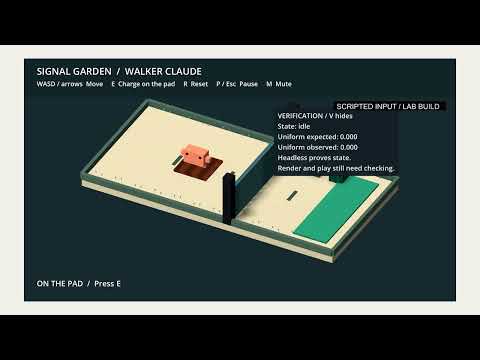
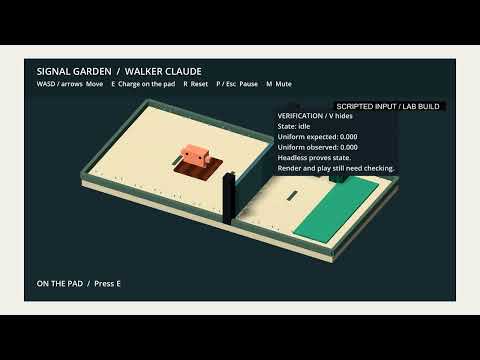
[1:31] Sequence shows V's diagnostic panel in the actual room. The capture uses physical key events. Every source frame was checked at 3840 by 2160 before encoding. The observer remains separate from gameplay authority. The observer reads the shaders declared uniform list. This matters because assigning and reading an arbitrary parameter can succeed even when the shader does not use it. An interface check must inspect the declaration, not just a round trip. Away from the pad, E does not begin a charge. The panel and game remain idle. That is a real scenario with a boundary, not a fabricated successful play. The next approach reaches the actual pad. The expected input is real charge divided by the committing action duration. The observer compares
It to the actual material value. It does not call the gameplay update for the test or write a successful state into the room. Watch the signal action. Charge and the observed uniform rise. The gate opens and the state changes. These are actual rendered consequences of normal input. They do not by themselves establish that a new player understood the feedback. In an isolated valid shader mutant, activation was renamed. Setting the undeclared name and reading it back really returned 0.5. The updated declaration probe rejected that contract. This is why a green roundtrip test can mislead. The earlier signal garden audit has a disclosed mutant that passes state checks but fails the native pixel oracle. The oracle computes expected colors independently
From the specification. A screenshot without a comparison is a record, not yet a verdict. The sequence reaches the destination, then resets. The observer follows the game through both cases. A useful instrument covers recovery and limits as well as the attractive successful moment. It still does not control the outcome. Nine fresh CPU runs used 60 warm-up and 300 measured frames. The updated observer's median was 1.14 micros per sample. This is headless CPU observation cost, not GPU timing or interactive frame rate. The native harness initially dispatched V twice, hiding the panel. A root window recording also failed the native resolution assertion. Real frames exposed both. Correct routing and explicit viewports repaired the instruments. Failed receipts were retained. Open the standalone starter.
Try The Three Exercises
[3:52] Run a failing check. Repair one concept and compare the solution. Three small parse valid gaps. Isolate the objectives. A script error would be a broken exercise rather than the intended learning failure. The starter returns brightness while the shader declares activation. Repair the method. Then run exercise one. Its check reads the declared list. It really fails on the starter and passes on the solution. The checker rejects the starter's undeclared name. The solution drives activation and passes. Neither result was inferred from a summary. Both actual commands and logs are retained. The starter returns zero for state value. The check sends e advances the real physics loop and compares charge to the uniform repair normalization. then explain why calling an update method directly would weaken this exercise. The starter accepts every evidence claim repair its distinctions. Uniform probes support state compared native frame support pixels and actual recorded human play supports feel. A renderer result does not supply the person. Use the tutorial and debugging guide. Run all three starter checks, then repair the gaps without weakening assertions. The solution is available for comparison. Explain each failure before calling it fixed. A passing check cannot certify your understanding. No
Teach And Hand Off Honestly
[5:10] Learner try out has occurred. The report labels effectiveness as predicted. The rubric gives an actual try out up to four points. Without one, honest predicted effectiveness earns at most one. Do not invent a learner's result. The core subtotal is 60. Brief six, concept and implementation 14. Tutorial 16, film 12, report 8, and try out 4. The show section uses actual game output. Try gives a repository challenge. Keep the game starter, solution, tutorial, debugging guide, report, and evidence together. Students match accessible source and film versions in their zip and canvas handoff. This instructor task has not published or submitted them. Frictional and matching access carry 10 each. Comparative placement carries 20. Be ready to explain the technique and actual failures. This instructor scaffold was I authored under bear's direction. No personal experience or human approval is manufactured.
Closing
[6:06] Let's recap with Claude. Choose evidence that can support the claim. Show real state native output and instrument failures. Build exercises that fail for the intended reason. Label predicted effectiveness until a real try out. Read my teaching starter and solution. Map each objective to an exercise and a check. Confirm that the starter parses but fails the intended assertions and the solution passes. Identify which claims need native frames and which need an actual learner. Do not invent a try out or personal reflection. Teach a verification loop at Nick Bear Brown.
More videos
 6:05
6:05Godot Particle Effects That Communicate Game State | Assignment 6
 5:54
5:54Godot Animation: Inspect Keys, Timing and Interruptions | Assignment 7
 3:17
3:17Pitch a Game You Can Actually Show | Assignment 8
 5:01
5:01Write a Game Design Document You Can Check | Assignment 4
 6:56
6:56Godot Shaders and Materials: Test What You Can Explain | Assignment 5 Walkthorugh
 7:28
7:28