AI Game Assets That Work Together: Art, Sound and Music | Assignment 2
Turn AI-generated art, sound and music into a playable Godot slice, then inspect what the generated assets actually do.
Turn AI-generated art, sound and music into a playable Godot slice, then inspect what the generated assets actually do.
See the storyboard and character design, a rejected biped silhouette, the corrected four-legged mascot, generation records and real synchronized game audio. A native capture exposes background ordering and collider alignment that logic tests alone missed. Visual design sheets were completed after the initial text plan; this instructor example preserves that chronology.
CSYE 7270, Assignment 2: Professor Bear’s worked example.
Your turn Read my concept, storyboard and character specification. Check that each planned asset has a play role. Propose one free or local generation request, with model terms and reproducibility fields. After generation, compare the actual output to the specification and recommend accept, edit or reject. Do not invent a playtest.
Chapters 0:00 Introduction 0:37 Design Before Generation 2:11 Generate And Inspect 3:37 Use The Real Slice 5:38 Explain And Hand Off 6:50 Closing
Sources and credits CSYE 7270 assignment brief; Walker Claude source, design records, test receipts and engine captures. Teaching direction: Nik Bear Brown. AI-assisted implementation, analysis and film production. Liam, in for Bear: synthetic Kokoro narration. Scripted engine input is labeled; no human playtest or learner approval is claimed.
Professor Bear Does His Assignments https://www.youtube.com/playlist?list=PLM51lFDKue_A
What this video covers
- 0:00 — Introduction
- 0:37 — Design Before Generation
- 2:11 — Generate And Inspect
- 3:37 — Use The Real Slice
- 5:38 — Explain And Hand Off
- 6:50 — Closing
Transcript
A lightly formatted transcript of the video, with timestamps so you can jump to any section on YouTube.
Introduction
[0:00] CSY7270 assignment walkthroughs generated assets that fit. Design the assets reject mismatches and test them in a real game. Hello, this is Liam in forbear for CSY7270. The assignment asks for assets that serve a design play experience. Walker Claude's asset slice connects actual model outputs to controls, events, and an inspectable revision history. Prerequisite terms. Asset a resource the game actually uses. State a condition the game tracks. Provenence where an output came from registration. Consistent placement of the art. Start
Design Before Generation
[0:37] With the play loop in a visual or audio job. Specify the asset. Generate one candidate. Then tested in the slice. A folder of impressive images does not establish a working game. The minimum includes a character in two static states and an environment. Four event sounds and one music loop. Procedural drawings and authored sign tones do not count as model generated outputs. Animation is not a minimum. Use free or local models and record terms. Avoid named artists, brands, copyrighted character prompts, and unapproved voice or likeness cloning. The ledger must distinguish source references, raw model outputs, and later edits. Our concept centers on movement, a committing signal, a gate, and recovery. The art should make those decisions readable and audio should
Confirm actual events. It is a design specification, not a promise that people find it fun. The storyboard specifies six panels and multiple views and angles. These sketches are constructed design intent. They do not pretend the slice implements camera transitions. Compare them to the actual play rather than silently replacing intent. The reference sheet gives 10 distinct original model poses. Keep facing, silhouette, pallet, and collision boundaries explicit. Mirroring is not another pose. These references are design output separate from the generated character images used in the slice. Planning documents were committed before inference. The completed storyboard and pose pictures came later. That does not earn the full before generation criterion. We retain the chronology instead of inventing an earlier completion date. Generate in
Generate And Inspect
[2:12] Small steps. Record the exact model revision prompt seed and output inspected against the design. Then accept, edit or reject. Keep rejected candidates. They explain why the next request changed. This example used local SD Turbo for images and Music Gen small for audio. Exact downloaded revisions are in the log. Music Gen's model weights have non-commercial terms. No paid generation or API key was used. The initial character candidate was a biped. Contrary to the design, it was rejected. Deriving candidates from the original model sheet restored the four-legged box body. Current state images still have modest pose differences. That limitation remains visible. The log records, prompts, seeds, step counts, model revisions, reference crops, and hashes. It records the biped and clip crop failures too. No imagined clawed conversation is substituted for the actual generation requests. The image edits extract an alpha silhouette and resize it. Audio edits trim cues, normalize levels, and fade edges. The music uses a recorded crossfade. Its process loop is 7.69 seconds. Editing does not turn a procedural drawing into MLR. Keep model terms, used assets, prompts, references, and editing scripts together. A seed is useful, but does not guarantee identical results on every device or version. The recorded outputs and hashes identify this specific example. The generated images and audio
Use The Real Slice
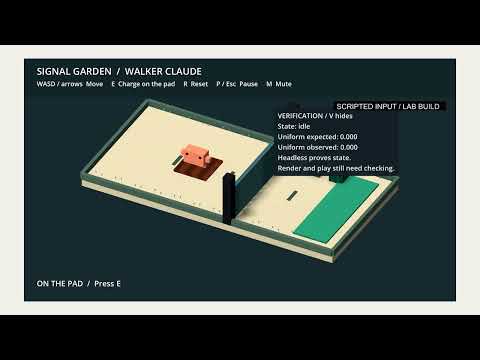
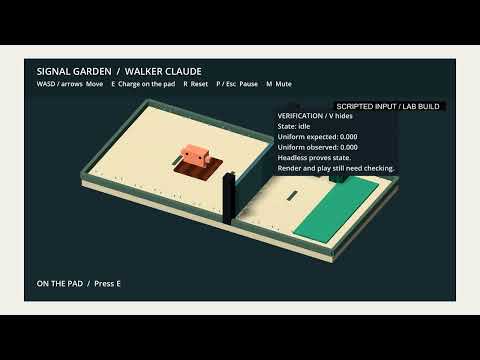
[3:39] Now serve a small controlled loop. Movement reaches the pad. A valid signal opens the gate. Completion and reset produce their own cues. The game owns those events, not the audio player. The slice has movement, charge, gate, reset, and finish sounds. Invalid action away from the pad does not play a charge cue. Music pauses with the game and stops at completion. Mute settings do not decide gameplay state. The next recording has no narration over it. It contains more than three music loops, movement, the charge, gate, completion, and reset. It is actual engine audio with scripted input, not a separately scored montage. >> >> The
First recording showed the background covering the pad and gate, moving it behind the geometry repaired presentation. Registering the image feet and correcting the oversized collider made alignment inspectable without altering the original course levels. This is a native debug collision frame. After alignment, the rectangle is 95x 86 pixels, offset 27 pixels down. Arms intentionally overhang it. The actual collision boundary is documented instead of being inferred from the picture. Automated checks establish specified state and resource conditions. Native frames establish visible output and actual audio presence. Human play with sound and muted musical suitability. Accessibility and design comparison remain human judgments. None is fabricated here. Trace one asset from
Explain And Hand Off
[5:39] Design through request, rejection or edit to the actual game event. Credit the model, AI code, and human direction separately. This lecture is the instructor's local example, not a claimed student submission. Students post matching source, used assets, documentation, and accessible media. Then identify the exact version in Canvas. Keep caches and credentials out. Run a fresh copy and check access separately. A local working folder does not prove posting. The implementation subtotal is 60. Design 12, generated art 14, sound and music 14, verification 10, and the explainer 10. Human checks and real playable integration matter. A generated gallery cannot replace them. Frictional carries 10 matching GitHub and canvas 10 and comparative placement 20. Meeting the fixed requirements can earn 80 not guarantee the comparative 20. Paid tools and animation are not automatic bonuses. Frictional records real attempts, judgments, contributions, and traceable evidence. Be ready to reproduce an asset or explain a rejection. AI can organize the record. It must not invent your personal experience or the human checks you did not perform.
Closing
[6:51] Let's recap with Claude. Specify the experience before generating assets. Log and inspect actual model outputs and edits. Test assets through real events, pictures, and audio. Hand off matching evidence and own the human judgments. Read my concept storyboard and character specification. Check that each planned asset has a play role. Propose one free or local generation request with model terms and reproducibility fields. After generation, compare the actual output to the specification and recommend, accept, edit, or reject. Do not invent a play test. Generated assets that fit at Nick Bear Brown.
More videos
 6:05
6:05Godot Particle Effects That Communicate Game State | Assignment 6
 5:54
5:54Godot Animation: Inspect Keys, Timing and Interruptions | Assignment 7
 6:41
6:41Teach Game-AI Verification with Three Runnable Exercises | Assignment 9
 3:17
3:17Pitch a Game You Can Actually Show | Assignment 8
 5:01
5:01Write a Game Design Document You Can Check | Assignment 4
 6:56
6:56