Walker Bullet Shower: A Design Document Around a Ghost
This recovered design document describes a tech demo with no goal, score, fail state, or ending. The film connects its mechanics and open questions to current source, capture logs, and isolated tests. Four approval gates remain unsigned, and human judgments about fun and audience remain open.
Walker Bullet Shower: A Design Document Around a Ghost
This recovered design document describes a tech demo with no goal, score, fail state, or ending. The film connects its mechanics and open questions to current source, capture logs, and isolated tests. Four approval gates remain unsigned, and human judgments about fun and audience remain open.
Chapters: 0:00 Reconstructed Walker prompt and two output lines that… 0:32 Header · 0 1:10 Reused same-build capture frames 910 onward: vertical… 1:41 § 7 Progression · § 9 Narrative · § 10 Characters:… 2:16 § 3 Core loop · honesty test: verbatim excerpt left, four… 2:55 Reused capture frames 1420 onward: mouse parked 3:24 § 11 Features · § 12 Out of scope: verbatim excerpt left,… 3:58 § 15 Open questions · Zelda’s notes: verbatim excerpt… 4:40 Handoff prompt typed in the composer, read aloud and discussed
https://github.com/nikbearbrown/walker-2d-bullet-shower
Liam in for Nik Bear Brown · AI-assisted; scripted-input Godot captures, no human playtest claimed.
What this video covers
- 0:00 — Reconstructed Walker prompt and two output lines that…
- 0:32 — Header · 0
- 1:10 — Reused same-build capture frames 910 onward: vertical…
- 1:41 — 7 Progression · § 9 Narrative · § 10 Characters:…
- 2:16 — 3 Core loop · honesty test: verbatim excerpt left, four…
- 2:55 — Reused capture frames 1420 onward: mouse parked
- 3:24 — 11 Features · § 12 Out of scope: verbatim excerpt left,…
- 3:58 — 15 Open questions · Zelda’s notes: verbatim excerpt…
- 4:40 — Handoff prompt typed in the composer, read aloud and discussed
Transcript
A lightly formatted transcript of the video, with timestamps so you can jump to any section on YouTube.
Reconstructed Walker prompt and two output lines that…
[0:00] Hi, this is Liam in forbear. This prompt is a reconstruction, not a saved chat. Use Walker to turn a design document about a moused-driven bullet demo into a God project. This document actually came the other way round. Walker read the finished code and wrote down what it found. This film walks through every section. This design document doesn't design anything. It recovers. 16 sections written from the code. Each claim tagged, observed, inferred, or missing. Most of them say missing on purpose. And the capture made for these films found one thing the document got wrong. Start
Header · 0
[0:33] With the header. Version 0.1 recovered. Written silently by Walker's Zelda agent. All four design gates are unsigned. The classification line is the thesis. Tech demo not a game. No goal score fail state or end. Every claim below carries a tag. Observed in the code inferred from it or missing. Section one. Vision. What it is observed. God's official bullet shower demo. 500 collision objects run through the physics server. No node per bullet. The player fantasy missing. A face frowns when touched and nothing gives you a reason to avoid anything. The audience is inferred. People reading the source and the big question stays open. A demo forever or the seat of a game.
Reused same-build capture frames 910 onward: vertical…
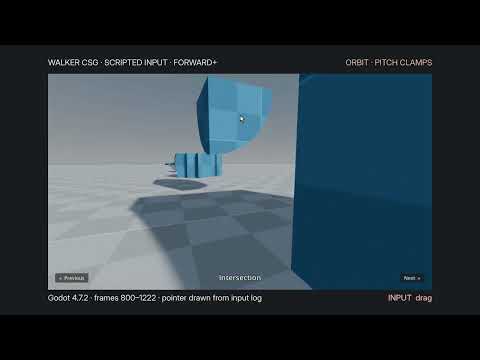
[1:10] Here is the thing it describes from the walkthrough's capture. A scripted mouse sweeping a full field. The face frowns while bullets overlap it. Nothing else happens and nothing is supposed to. Sections two and four are the ghost center. No design pillars. The codes one principle is an engineering rule. One manager owns every bullet and the document refuses to promote it to a player pillar. No player experience goals either. Just one candidate px01. A viewer can see that bodies without nodes still collide. A candidate not approved. Hold on to that one. Three more sections
7 Progression · § 9 Narrative · § 10 Characters:…
[1:42] Are nearly empty and each says why. Progression, count, speed, and spawn band are constants, so nothing escalates. Narrative, no text, no dialogue, and the document won't invent any characters. One unnamed face with two frames. Happy and sad. Whether it gets a name is question five for a human. Section three, the core loop redrawn here. Enlarge type. Mouse motion is the only input. The player jumps to the cursor minus 16 pixels. Bullets move left and wrap. Overlaps drive a counter and the counter picks the face. The dashed box is the layer a game would need. Goal or consequence. It doesn't exist. Then the document runs its own
3 Core loop · honesty test: verbatim excerpt left, four…
[2:17] Loop honesty test. Strip the faces and you have a cursor and moving circles. Nothing is decided, risked, or rewarded. It calls the result an observation loop and marks the test failed, which is the right answer for a demo. A design document that can fail its own test is doing its job. Section five lists four mechanics, all observed in code. Cursor follow with no smoothing and no bounds. The bullet field 520 to 80 pixels a second wrapping at the left edge. Server bodies, one shared circle switched by walker to static mode. In M03, the contact face enters one exit subtracts one. That's exactly what the code says. It isn't quite what the engine does. The
Reused capture frames 1420 onward: mouse parked
[2:55] Capture disagrees. The mouse is parked. Bullets drift through the face and it stays happy. The counter reads zero. One pixel of motion and it jumps to two. Systems world and technical constraints are short and correct. Two systems. The bullet manager and the player's contact counter. No save, no scene changes, no audio, no interface. One canvas sized by the window, no background art. God 4.7 the compatibility renderer raw mouse motion and three headless test scripts
11 Features · § 12 Out of scope: verbatim excerpt left,…
[3:24] Features and scope four features are implemented in verified headless the fifth the visible gameplay capture is marked not done these films did it that updates the row it approves nothing out of scope score victory restart screens music mechanics and no speed up is claimed without a benchmark risks and tests risk one collision geometry drifting from the drawings under the default body mode reproduced then fixed with static bodies. The three headless tests pass again today, but none of them parks the player, and that is the gap the capture fell into. The fix for risk one created a risk the document doesn't list. Section 15 hands six questions to
15 Open questions · Zelda’s notes: verbatim excerpt…
[4:00] A human. Demo or game, who it's for, what a viewer should take away, whether it has pillars, whether the face gets a name, and whether a benchmark comes before any speed claim. All six are open. Zelda's closing notes name the pattern ghost center and call the static body fix the most interesting fact in the folder. The capture agrees for a reason Zelda couldn't see. The verdict. This is an honest recovered document. Every empty section says why it's empty and the tags keep observed apart from guest. It's one wrong sentence is M03. Enter and exit are the codes promise and a park player breaks it. Its missing row is the risk that caused that the static body fix changed contact detection. Six questions and four gates still belong to a person. Your turn. Paste this into
Handoff prompt typed in the composer, read aloud and discussed
[4:41] Claude with your own recovered document. Take px01 from my recovered GDD. The viewer can see that server managed bodies really collide. Rewrite it as one testable sentence. Name the recording that could prove it wrong and list what must stay unchanged while I test it. Watch whether Claude asks for a still player. This film's capture already falsifies the sentence as written. A good test finds that Liam in for bear walker bullet shower a design document around a ghost at Nick Bear