Walker CSG: A Design Document With No Picture
This recovered design document specifies a twelve-specimen CSG tech demo and a select, slide, orbit, zoom, repeat loop. The film compares proposed requirements with same-build capture evidence and the current 46-of-46 input test. Surface presence is shown; boolean correctness remains an open measurement.
Walker CSG: A Design Document With No Picture
This recovered design document specifies a twelve-specimen CSG tech demo and a select, slide, orbit, zoom, repeat loop. The film compares proposed requirements with same-build capture evidence and the current 46-of-46 input test. Surface presence is shown; boolean correctness remains an open measurement.
Chapters: 0:00 Reconstructed Walker prompt and two output lines that… 0:37 Header · 0 1:10 Reused same-build capture, no-input phase: Union specimen 1:43 Reused capture boolean phase: Subtraction then… 2:13 § 5 Mechanics: verbatim excerpt left, four cue-lit cards right 2:47 § 6 Systems: verbatim excerpt left, four cue-lit cards right 3:18 § 7 Progression · § 8 World · § 9 Narrative · § 10… 3:55 § 13 Technical: verbatim excerpt left, four cue-lit cards… 4:33 § 15 Open questions · Zelda’s notes: verbatim excerpt… 5:10 Handoff prompt typed in the composer, read aloud and discussed
https://github.com/nikbearbrown/walker-3d-csg
Liam in for Nik Bear Brown · AI-assisted; scripted-input Godot captures, no human playtest claimed.
What this video covers
- 0:00 — Reconstructed Walker prompt and two output lines that…
- 0:37 — Header · 0
- 1:10 — Reused same-build capture, no-input phase: Union specimen
- 1:43 — Reused capture boolean phase: Subtraction then…
- 2:13 — 5 Mechanics: verbatim excerpt left, four cue-lit cards right
- 2:47 — 6 Systems: verbatim excerpt left, four cue-lit cards right
- 3:18 — 7 Progression · § 8 World · § 9 Narrative · § 10…
- 3:55 — 13 Technical: verbatim excerpt left, four cue-lit cards…
- 4:33 — 15 Open questions · Zelda’s notes: verbatim excerpt…
- 5:10 — Handoff prompt typed in the composer, read aloud and discussed
Transcript
A lightly formatted transcript of the video, with timestamps so you can jump to any section on YouTube.
Reconstructed Walker prompt and two output lines that…
[0:00] Hi, this is Liam in for Bear. This prompt is a reconstruction, not a saved chat. Use Walker to turn a design document about a gallery of constructive solid geometry into a Godot project. This document actually came the other way round. Walker read the finished demo and wrote down what it found. This film walks through every section. This design document doesn't design anything, it recovers. 16 sections written from one scene file, every claim tagged observed, inferred, or missing. It's sharpest admission, the subject of the demo is how the shapes look, and when it was written, no Walker capture had shown them rendering. The capture made for these films is the first.
Header · 0
[0:37] The header first, version 0.1 recovered, written silently by Walker's Zelda agent. All four design gates are unsigned, and the project kind is the thesis, a tech demo, a gallery of solid geometry specimens, not a game. Section one, vision. What it is, 12 specimens, three Boolean operations, four extrusions, a curved cut, a pillar, a beveled cube, a road, observed. The upstream purpose is quoted, prototype level designs. The player fantasy, none. And the biggest open question, is this a reference card or a level blocking lesson? The code only supports the first.
Reused same-build capture, no-input phase: Union specimen
[1:10] Here is the thing it describes from the walk-through's capture before any input. Specimen one, union, rendered at 4K. When the document was written, only upstream screenshot existed, no Walker capture. Sections two and four, no pillars are stated. The document infers two from structure, same framing, different operation an editor authored with zero run-time code. It refuses to call them approved, no player experience goals, either. The one candidate outcome, unconfirmed. A viewer predicts union, subtraction, and intersection before the camera arrives.
Reused capture boolean phase: Subtraction then…
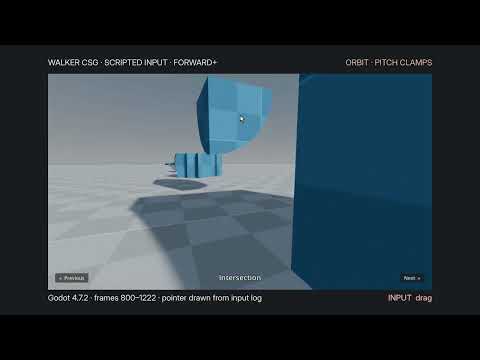
[1:43] The capture tests rule one, union, then subtraction, then intersection from the same viewpoint, three different solids from one box and one sphere. That's proposed test T11, now run as a capture. Whether a first-time viewer predicts them is still a human test. Section three, the loop redrawn here in large type. Select a specimen with the arrows or the buttons. The camera slides along the row. Orbit and zoom. Repeat. There is no end state. The dashed box is the visible check in the films proposed when this was written.
5 Mechanics: verbatim excerpt left, four cue-lit cards right
[2:13] Section five, three mechanics. Stepping clamped zero to 11 with the end buttons disabled. Orbit and zoom with its tuning numbers. A zoom speed of 0.125 distance from 1 and 1/2 to 6. And a light fallback for the adaptability renderer. The document is careful. Those are tuning values, not approved design. And the wheel test covers press events only. That caveat mattered. In the capture, each wheel notch is sent the way Godot delivers one, a press and a release. The script counts both. So, a notch moves a quarter unit, not an eighth. 10 notches reach the near limit. The documents risk R04 guest exactly here.
6 Systems: verbatim excerpt left, four cue-lit cards right
[2:47] Section six, systems. The specimen row, 12 nodes from union at line 79 to road at 363. A camera rig of three nested nodes. No input map, only the built-in actions. No custom signals. And one honest line, every specimen generates a mesh surface. And surface presence is not Boolean correctness. The capture looks at what proposed test T13 names, the beveled cube after the pillar. The bevels render as shaded faces with no hole visible at this distance. That is a look, not a measurement of normals.
7 Progression · § 8 World · § 9 Narrative · § 10…
[3:18] Four sections are nearly empty and each says why. Progression, none, though the order runs simple to compound from one Boolean pair to a path sweep. World, a lab, a sky, one shadowed light, a checker floor. Narrative, none. Correctly, characters, none. Nothing invented to fill them. Features and scope. Four features exist and are input tested. F05, visible GPU verification is marked no proposed. F06, two native 4K films, the same. This capture and these films are those rows. They update the rows. They approve nothing. Out of scope by absence, runtime CSG editing, collision, baking to meshes, audio saving.
13 Technical: verbatim excerpt left, four cue-lit cards…
[3:55] Section 13, technical. Godot 4.7 forward plus by default, four times multi-sampling, a big shadow atlas, and low processor mode on, the window only redraws on change. The document flags that is a capture trap. In this offline movie capture, every one of the frames was drawn. That says nothing about a live window. Risks and tests, R01, surfaces exist, quoted as CSG works. This film tries not to. R04, the wheel increment per notch never measured, now measured at double. The existing test rerun today, 46 of 46 pass, and the proposed human test is still unwritten, a person predicting each Boolean before the camera arrives.
15 Open questions · Zelda’s notes: verbatim excerpt…
[4:33] Section 15, hand six questions to a human. What the films teach, the pillars reference or level blocking, low processor mode during capture, priorities, and how Boolean correctness will be judged. All six are open. Zelda's notes name the ghost center in her first fix. Answer the reference or prototyping question because the two need different films. The verdict, an honest recovered document. Every blank says why, and it drew the right line between surfaces and correctness. It's guess about the wheel was right, and the capture measured it double. It's capture trap didn't bite in movie mode. The capture it lacked now exists. Six questions and four gates still belong to a person.
Handoff prompt typed in the composer, read aloud and discussed
[5:10] Your turn. Paste this into Claude with your own recovered document. Take question six. How will Boolean correctness be judged? Write one testable criterion for the subtraction specimen. Name the measurement that could prove it wrong, and say what a person must still look at. Watch whether the answer confuses a surface existing with a surface being right. Liam, in for Bear. Walker CSG, a design document with no picture, at Nick Bear Brown.
More videos
 3:36
3:36Walker CSG: Twelve Solids and a Wheel That Counts Twice
 5:05
5:05Walker CSG: Twelve Solids and No Geometry Code
 5:22
5:22Walker Bullet Shower: 500 Bullets, No Nodes, One Side Effect
 5:09
5:09Walker Bullet Shower: A Design Document Around a Ghost
 1:54
1:54The Same Experiment, One Floor Up
 2:05
2:05