Walker CSG: Twelve Solids and No Geometry Code
One scene file and one 78-line script present twelve CSG specimens without geometry code in the script. The film pairs exact source excerpts with logged results for selection, orbit, zoom, labels, and tests. It identifies a wheel-input test that sends press events but never releases.
Walker CSG: Twelve Solids and No Geometry Code
One scene file and one 78-line script present twelve CSG specimens without geometry code in the script. The film pairs exact source excerpts with logged results for selection, orbit, zoom, labels, and tests. It identifies a wheel-input test that sends press events but never releases.
Chapters: 0:00 Reconstructed Walker prompt 0:33 Saved scene skeleton beside scene-file counts 1:02 Capture p01: Union specimen at the default view 1:28 Capture p02: Subtraction, then Intersection, same viewpoint 1:56 Capture p03: yaw drag 2:22 Capture p04: press+release pairs 2:56 csg 3:31 Capture p08: Road 3:59 test_input 4:39 One test + prediction, read aloud
https://github.com/nikbearbrown/walker-3d-csg
Liam in for Nik Bear Brown · AI-assisted; scripted-input Godot captures, no human playtest claimed.
What this video covers
- 0:00 — Reconstructed Walker prompt
- 0:33 — Saved scene skeleton beside scene-file counts
- 1:02 — Capture p01: Union specimen at the default view
- 1:28 — Capture p02: Subtraction, then Intersection, same viewpoint
- 1:56 — Capture p03: yaw drag
- 2:22 — Capture p04: press+release pairs
- 2:56 — csg
- 3:31 — Capture p08: Road
- 3:59 — test_input
- 4:39 — One test + prediction, read aloud
Transcript
A lightly formatted transcript of the video, with timestamps so you can jump to any section on YouTube.
Reconstructed Walker prompt
[0:00] Hi, this is Liam in for Bear. The prompt on screen is a reconstruction, not a saved chat. Use Walker to turn a design document about a gallery of constructive solid geometry into a Godot project. This film opens the result up. A few lines of the project, then what they do on screen in the real engine. What was built? One scene file and 178 line script. Every solid you'll see a scene data, nested CSG nodes with an operation property. The script never touches geometry. It only moves the camera and the label. That split is the lesson and it's where the one bug lies.
Saved scene skeleton beside scene-file counts
[0:33] Start with the saved scene tree. The root is a world environment carrying the script. A floor plane, one sun, a camera rig of three nested nodes, and a testers node holding the 12 specimens. Then a label and two buttons, two signal connections in the whole file. Specimen one union, a 2 m CSG box and a sphere nested inside it as a child. No operation line on the sphere, so it uses the default union. The sphere sits 1 m off center and gets the second material.
Capture p01: Union specimen at the default view
[1:02] And there it is, rendered. One solid, box and sphere merged. No seam where they meet. Subtraction is the same pair with one extra line, operation equals two. Intersection a few lines further down says operation equals one. Everything else, sizes, positions, materials, is identical.
Capture p02: Subtraction, then Intersection, same viewpoint
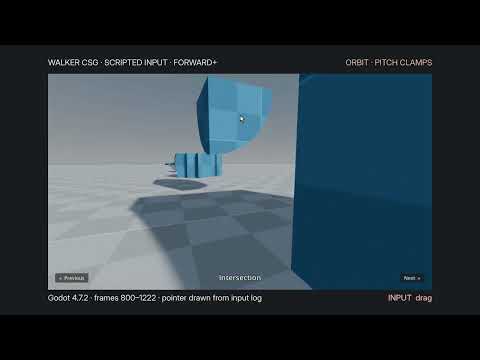
[1:28] Right arrow, the sphere carves a bite out of the box. Right again, only the shared volume is left. Orbit is in the script, only motion with a mouse button held counts. Screen relative motion * 0.003 turns yaw and pitch. Pitch is clamped between -1.57 and 0, straight down to the horizon. Then two basis rights.
Capture p03: yaw drag
[1:56] Drag sideways, the view turns. Drag down, it stops looking straight down. Drag up, it stops at the horizon. Zoom, look at what's checked here, the button index, not whether the button is pressed. Godot sends a wheel notch as a press and a release. Both are mouse button events with the same index, so both subtract the zoom speed.
Capture p04: press+release pairs
[2:22] 10 notches and reach the near limit of 1 and 1/2. The log shows a quarter unit per notch, both events counted. Staircase spin reuses the staircase outline, but mode equals one, spin 90° and 32 sides, so it's a quarter turn, not a full circle. The quarter turn staircase then curves, a box with a cylinder cut out and a box keeping only the cylinders overlap.
csg
[2:56] The beveled cube, 12 thin boxes, each rotated 45° and subtracted along one edge. Then a sibling called whole fix, a slightly smaller box. Its name suggests it patches gaps the cuts leave. The file doesn't say more. Pillar then the beveled cube, edges cut to faces, read from this distance as one solid. The road, a polygon in mode two path. It follows a path 3D sampled every 0.1 m joined end to end with smooth faces. A second polygon the top uses the same path.
Capture p08: Road
[3:31] The swept road and the end of the row next graze out and further clicks do nothing. Stepping previous and next clamp the index then update the label and the two buttons. The label is the node name capitalized. That's why beveled cube gets a space. 11 left arrows, the camera slides back along the row and previous disables at Union.
test_input
[3:59] Now the test zoom check, 60 wheel up events each a press only, never the release. So each one moves an eighth. The limits are reached either way and the check passes. It proves the clamp, not the step size. Rerun today on an isolated copy, 46 of 46 pass exit zero. Every pass is real. None of them measures how far one notch moves the camera. The verdict implemented 12 solids as seen data in a 78 line camera script. Tested 46 headless checks, all pass. Found the wheel handler ignores pressed, so a notch zooms double in the tests press only events hide it. Not checked boolean correctness beyond the look. For person, is double zoom a bug or a feel you'd keep?
One test + prediction, read aloud
[4:39] Your turn on a copy of Walker 3D CSG, add one test that sends one wheel notch as a press and a release and asserts the distance changes by the zoom constant. Predict the result, run it on the unchanged script, and only then decide whether the script should check pressed. Write the prediction down first. A red test here is the bug made executable. Lay him in for bear. Walker CSG, 12 solids and no geometry code, at Nick Bear Brown.